 DALY
DALY 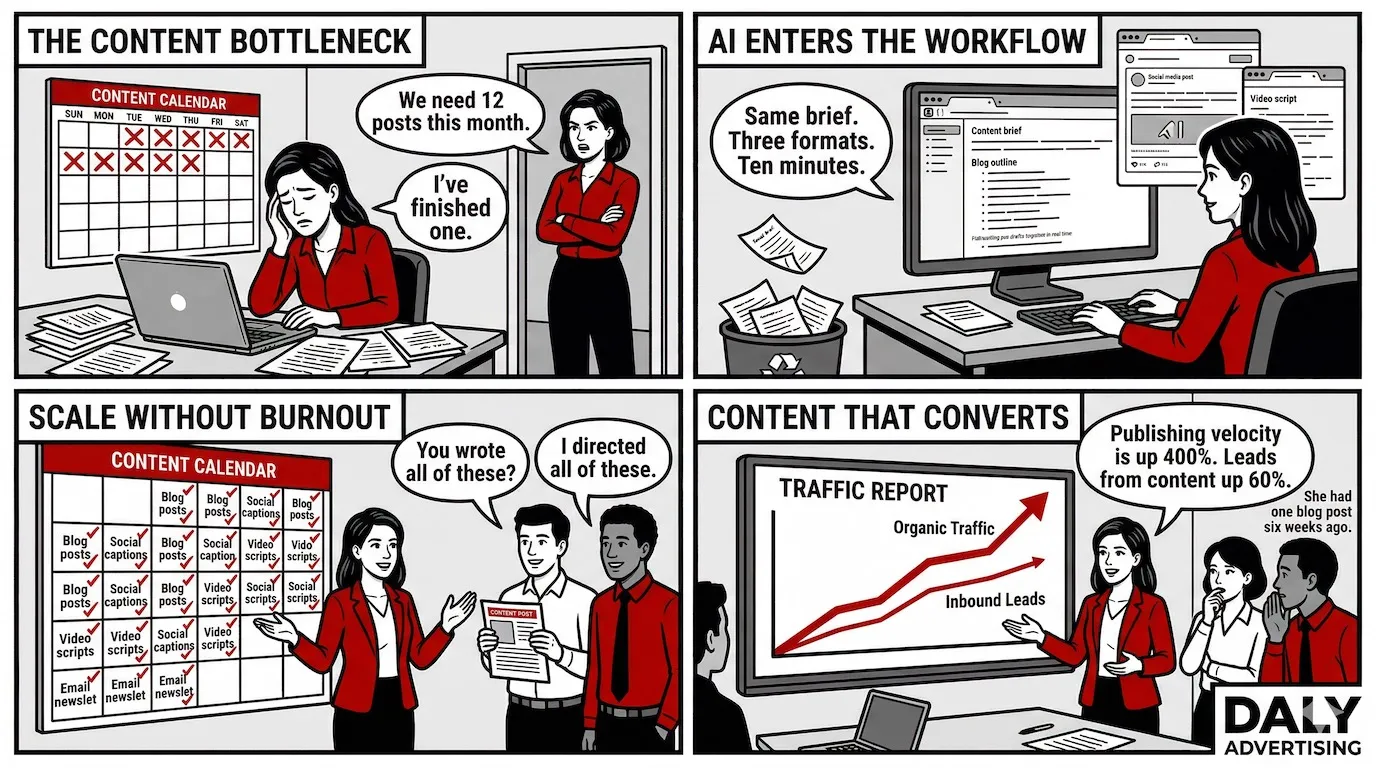
Companies with documented AI content strategies are 397% more likely to report success than those without one. That number isn't a rounding error - it's the difference between teams that treat AI as a party trick and teams that built it into how they operate.
Most marketing teams are stuck at tier one: someone uses ChatGPT to speed up a blog post, the team calls it "AI-powered," and nothing fundamentally changes. Meanwhile, the teams running full AI content pipelines - automated research, structured briefs, AI-assisted drafts, SEO optimization, and multi-channel distribution - are producing 3 to 5 times more content per month without adding a single hire. The gap between those two groups is widening every quarter.
This guide covers the full system: what a real AI content workflow looks like, which tools actually justify their cost, how to build an AI SEO content strategy that doesn't get torched by a Google core update, and the math that proves whether any of this is worth your budget. No tool vendor comparisons dressed up as strategy. No vague advice about "embracing AI." Just the operational specifics that separate a content machine from a faster typewriter.
What AI Content Marketing Actually Means (Not the Hype Version)
Most teams think they're doing AI content marketing because someone on the team uses ChatGPT to write blog posts. That's not a strategy. That's a faster typewriter.
Real AI content marketing is operational infrastructure. It's a documented system where AI handles research, brief generation, drafting, optimization, and distribution - connected through automation so the output is repeatable, not random. The difference between a writer using Claude once a week and a team running a full AI content pipeline is the difference between a hammer and a factory. Same raw material, completely different output rate.
There are three tiers of AI adoption, and most teams are stuck at tier one:
- Tier 1 - Assisted: AI helps individual contributors write faster. A human still drives every decision. Output improves by maybe 20-30%. This is where 80% of teams live.
- Tier 2 - Augmented: AI is embedded in the workflow. Briefs are generated automatically, drafts go through AI optimization before human review, and distribution is partially automated. Output increases 2-3x.
- Tier 3 - Autonomous: AI agents handle end-to-end content production for defined content types - topic research, drafting, SEO scoring, publishing - with humans reviewing final output rather than building it. Output scales 5x or more.
The reason teams stall at tier one is documentation. They adopt a tool, not a process. Someone figures out a good ChatGPT prompt, uses it for a month, then leaves the company. The institutional knowledge walks out the door because it was never written down. CoSchedule found that companies with documented AI content strategies are 397% more likely to report success than those without. That gap exists entirely because of process documentation, not tool selection.
61% of marketers say AI is the most important aspect of their data strategy, according to Salesforce. The global AI in marketing market is projected to hit $107.5 billion by 2028. Those numbers aren't interesting because they're large - they're interesting because they tell you where your competitors are investing right now.
The teams who reach tier two and three by the end of 2026 will have a cost and speed advantage that's nearly impossible to close without matching their systems. Not their tools. Their systems.
How AI Content Marketing Works: The 5-Stage Pipeline
A full AI content pipeline has five stages. Most teams only automate one or two and wonder why their results don't match the case studies. Here's what the full system looks like when it's actually running.
Stage 1: Research Automation
This is where the biggest time savings live. AI tools can reduce content research time by up to 70% when combined with automated workflow pipelines. Instead of a writer spending 3 hours manually pulling keyword data, identifying SERP features, and mapping competitor gaps, an automated research layer does it in under 20 minutes. Tools like Semrush Copilot, Ahrefs, and Perplexity handle keyword clustering and competitor analysis. The output feeds directly into stage two.
Stage 2: Brief Generation
A brief is where strategy meets execution. AI takes the keyword and research data from stage one and generates a structured content brief: target keyword, secondary keywords, H2 structure mapped to search intent, data points to include, internal link targets, FAQ questions pulled from People Also Ask. This brief is the single most important document in the pipeline because it's what controls the quality of the draft. Skip this stage and your AI drafts will be generic. Build this stage well and the drafts are 70% of the way there before a human touches them.
Stage 3: AI-Assisted Drafting
This is the stage people over-automate. AI drafts well for evergreen SEO content, product descriptions, email sequences, and social copy. It drafts poorly for original research articles, thought leadership, source-based journalism, and anything requiring a named expert's perspective. The rule is simple: if the content's value comes from information that exists on the internet, AI can draft it. If the value comes from information that doesn't exist yet, a human has to create it first.
Stage 4: The Optimization Layer
Before a human reviews the draft, it runs through an automated optimization layer. Surfer SEO or Clearscope scores the content against top-ranking pages for keyword coverage. A readability check flags sentences over 30 words and passive voice density. An internal link suggestion engine matches the content against your existing page inventory. By the time a human editor sees the draft, it's already SEO-ready at a technical level. The editor's job shifts from building to refining.
Stage 5: Distribution and Repurposing
One published article isn't the finish line - it's the source asset. A 2,500-word blog post repurposes into: a LinkedIn carousel (5 key points), a short-form video script (60 seconds), an email newsletter section, 3-5 social posts, an FAQ schema block, a YouTube description, and an internal training doc if the content is technical. That's 8 assets from one production cycle. Most teams publish and move on. That's leaving most of the value on the table.
Where Human Review Fits
Removing human review entirely is where AI content pipelines break down. Not because AI writes badly, but because AI writes confidently - including when it's wrong. A human review checkpoint between stage three and publishing catches factual errors, brand voice drift, and claims that need sourcing. McKinsey's 2023 research found businesses using AI for content report up to 50% reduction in production time. That's with human review still in the loop. The teams that skip it save another 15% of time and spend twice as long fixing the problems it creates.
Want a pipeline like this running for your team? See how we build workflow automation for marketing teams that connects every stage into one repeatable system.
Best AI Content Marketing Tools: An Honest Breakdown
72% of high-performing marketing teams use AI tools for content personalization, according to HubSpot's 2024 State of Marketing report. The problem isn't tool availability - there are hundreds. The problem is knowing which tools belong in which stage of the pipeline and which ones are just expensive subscriptions that duplicate what you already have.
Research and Ideation
Perplexity is the fastest way to generate source-backed research summaries. Use it for understanding a topic quickly and identifying angles competitors haven't covered. Semrush Copilot integrates AI directly into keyword and competitor data - if you're already paying for Semrush, this is included and worth using. Ahrefs' AI features are more limited but useful for cluster mapping if Ahrefs is your primary SEO tool. Verdict: Perplexity for research speed, Semrush Copilot if you're already in the Semrush ecosystem.
Drafting and Generation
Claude (Anthropic) produces the most natural long-form prose and handles complex instructions better than any other model at this writing. Use it for anything over 800 words. GPT-4o is faster and better for structured outputs like tables, JSON, and templated formats. Jasper adds workflow scaffolding around the AI layer, which is useful if your team has non-technical users who need guardrails. At $49/month, Jasper is justified if it replaces process management overhead. If your team can work directly with Claude or GPT-4o, Jasper is redundant.
SEO Optimization
Surfer SEO at $99/month is the entry point. It scores your content against top-ranking competitors and tells you exactly what's missing. Clearscope at $170/month is more accurate and integrates directly into Google Docs, which matters for teams that still edit in Docs. MarketMuse starts higher and is best suited for enterprise teams building large topic cluster architectures. Verdict: start with Surfer SEO. Upgrade to Clearscope when your team is publishing more than 15 articles per month.
Workflow Orchestration
This is the layer that turns a collection of AI tools into an actual pipeline. n8n self-hosted starts at $0 and handles complex multi-step workflows. It requires technical setup but pays back the investment at scale. Make (formerly Integromat) is the middle ground - visual, flexible, and starts at $9/month. Zapier is the most accessible but costs $19.99/month at the base tier and becomes expensive fast at scale. Verdict: n8n for teams with technical capacity, Make for everyone else.
| Tool | Stage | Starting Cost | Best For | Verdict |
|---|---|---|---|---|
| Perplexity Pro | Research | $20/mo | Topic research, source discovery | Use it |
| Semrush Copilot | Research | Included in Semrush | Keyword and competitor data | Use if already on Semrush |
| Claude (Pro) | Drafting | $20/mo | Long-form content, complex briefs | Primary drafting tool |
| GPT-4o | Drafting | $20/mo | Structured outputs, templates | Secondary - use for formats |
| Jasper | Drafting | $49/mo | Non-technical teams needing guardrails | Skip if you can use Claude directly |
| Surfer SEO | Optimization | $99/mo | On-page scoring, content gaps | Start here |
| Clearscope | Optimization | $170/mo | High-volume teams, Docs integration | Upgrade at 15+ articles/mo |
| n8n | Orchestration | $0 (self-hosted) | Complex pipelines, technical teams | Best cost/power ratio |
| Make | Orchestration | $9/mo | Visual workflows, non-technical teams | Recommended default |
| Zapier | Orchestration | $19.99/mo | Simple automations, small teams | Only if already using it |
The minimum viable stack for a team under 5 people: Claude Pro ($20), Surfer SEO ($99), Make ($9), and Perplexity Pro ($20). That's $148/month to run a content pipeline that produces more than most 3-person content teams. The tools are not the expensive part. Your time is.
AI Content Strategy: Building a System That Runs Without You
Before you automate anything, audit what you already have. This is where most teams get it wrong - they buy AI tools and point them at a broken content strategy, then blame the tools when nothing improves. AI scales what works and amplifies what doesn't. A content audit first tells you which content types are generating traffic and leads, which pages have thin coverage worth expanding, and which topics you're missing entirely. That data becomes the input for your AI pipeline. Without it, you're automating guesswork.
Mapping Content Types to AI Capability
Not everything should be AI-generated. The honest breakdown:
- AI does well: evergreen SEO articles, product descriptions, email sequences, FAQ pages, social captions, meta descriptions, schema markup, content repurposing, internal linking suggestions
- AI does poorly: original research, expert interviews, brand voice development, opinion pieces with genuine stakes, case studies requiring real client data, crisis communications
The pattern is clear. If the content's value comes from synthesis and structure, AI handles it. If the value comes from an original perspective or proprietary data, humans create it and AI supports formatting and distribution. Mixing these up is what produces AI content that reads like it was written by someone who read about the topic but never lived it.
Building Topic Clusters at Scale
AI accelerates pillar-and-cluster architecture better than any other content task. The workflow: feed a seed keyword into a research tool, generate a full topic cluster map (pillar page + 10-15 subtopic pages), prioritize by search volume and competition index, then build briefs for each subtopic automatically. What used to take a content strategist a full week now takes an afternoon. The output isn't just faster - it's more thorough because the AI surface area for related questions is broader than what any one human would generate manually.
Realistic Output Benchmarks by Team Size
- Solo operator with AI pipeline: 8-12 articles per month at 1,500-2,500 words each
- 2-person team (one strategist, one editor): 20-30 articles per month
- 5-person team with full AI pipeline: 60-80 articles per month
Without AI, those same teams produce roughly one-fifth of that volume. AI-assisted teams produce 3-5x more content per month without adding headcount. That's not a marginal improvement - it's a structural competitive advantage that compounds over time as content indexes and ranks.
The Documented Workflow Requirement
CoSchedule's data is blunt: companies with documented AI content strategies are 397% more likely to report success. Undocumented AI processes collapse in about 60 days because the workflow lives in one person's head. When that person is out, sick, or gone, the system stops. Documentation doesn't need to be elaborate - a step-by-step process doc in Notion with the tools, prompts, review checkpoints, and publishing checklist is enough. The teams who skip this step treat AI as a shortcut. The teams who document treat it as infrastructure.
Human-in-the-Loop vs Fully Automated
High-volume, low-stakes content - social posts, meta descriptions, FAQ schema, email subject line variants - can run fully automated. Content that shapes brand perception or closes commercial deals needs human review before it publishes. The dividing line is consequence. If a bad output gets fixed in 10 minutes with no real damage, automate it. If a bad output appears on your homepage or in a sales email to 50,000 contacts, a human reviews it first. For the content types where speed matters most and stakes are lowest, AI agents for content workflows handle the full cycle without manual handoffs - research through publishing - while humans stay in the loop for strategy and final review on high-stakes pieces.
Content marketing already generates 3x more leads than outbound at 62% lower cost, according to DemandMetric. An AI-powered content system multiplies that advantage because it removes the production bottleneck that keeps most teams from publishing consistently. Consistency is the variable that compounds. Irregular publishing is the most common reason good content strategies fail - not content quality, not strategy, not budget. Just inconsistency. AI removes the excuse.
AI SEO Content: How to Rank Without Getting Penalized
Google's March 2024 core update was not subtle. Sites with 30% or more AI-only pages saw an average 27% traffic drop. Not because the content was AI-generated, but because it was thin, unoriginal, and failed to demonstrate any real-world expertise. The distinction matters, because AI-assisted content that ranks well is everywhere right now.
What Google's Guidelines Actually Say
Google's official position hasn't changed since the helpful content system launched: it doesn't care how content is produced. It cares whether content is useful, accurate, and written for humans first. The 2024 update penalized mass-produced, low-effort AI output, not AI involvement itself. The sites that recovered fastest shared one trait - every article had a human fingerprint: a specific data point, a named source, a perspective you couldn't generate from a prompt alone.
The practical implication: AI can write 80% of your article. But that remaining 20% - the original insight, the sourced quote, the experience-based claim - is what separates content that ranks from content that gets filtered out.
The E-E-A-T Problem and How to Fix It
Pure AI output fails E-E-A-T (Experience, Expertise, Authoritativeness, Trustworthiness) on the first letter. AI has no experience. It has training data. Fixing this is less about rewriting and more about adding what AI structurally cannot produce on its own.
- Experience signals: first-person case data, client results with specific numbers, screenshots of actual campaign performance
- Expertise signals: named author with credentials, cited primary sources (not AI-hallucinated ones), accurate technical details
- Authoritativeness signals: external links to primary research, mentions from other authoritative domains
- Trustworthiness signals: accurate dates, honest limitations, no inflated claims without attribution
Every article in your AI content pipeline should go through a human E-E-A-T pass before publishing. This takes 15 to 20 minutes per article. It's the difference between content that compounds and content that quietly disappears from search results.
On-Page SEO Automation at Scale
AI SEO tools reduce on-page optimization time from 2 hours to 20 minutes per article. That's not a rounding error - that's the difference between publishing 4 articles a month and publishing 20. Tools like Surfer SEO and Clearscope analyze top-ranking pages and return exact keyword targets, semantic terms, and heading structures. You give that brief to your AI drafting layer, and the optimization is built in from the start.
Schema markup is the most underused piece of this stack. AI can generate FAQPage, HowTo, Article, and BreadcrumbList schema in seconds from finished content. Most teams skip it because it feels technical. That's a mistake, because FAQ schema is what gets you the featured snippet placements that drive 20 to 30% click-through rate premiums over standard organic results.
The Metrics That Actually Prove It's Working
| Metric | What It Tells You | Target Benchmark |
|---|---|---|
| Indexed pages per month | Whether Google is crawling and trusting your output | 85%+ index rate within 30 days |
| Average position by cluster | Whether topic depth is improving rankings | Position improvement in 60-90 days |
| Featured snippet captures | Direct-answer content performance | 1 snippet per 10 published articles minimum |
| Organic CTR | Whether title tags and meta descriptions are converting impressions | 3-5% for informational, 5-8% for commercial |
| Pages with 3+ backlinks within 90 days | Whether content is authoritative enough to earn links | 15-20% of published articles |
The number that most teams ignore is indexed pages per month. If you're publishing 20 articles and only 12 are getting indexed within 30 days, your AI content quality signal is weak. Fix the quality before scaling the volume.
AI Content Marketing ROI: Show the Math Before You Buy the Tools
Before you sign up for another SaaS subscription, run the numbers on what you're actually spending right now. Most marketing teams significantly underestimate the fully loaded cost of human content production because the costs are spread across salaries, tools, and time that never shows up in one line item.
The Real Cost of Human Content Production
A senior content marketer in the US costs between $85,000 and $110,000 per year in salary alone. Add benefits (roughly 30% of salary), tools like Ahrefs, Semrush, or Clearscope ($300 to $600/month), and the opportunity cost of management time, and you're looking at $125,000 to $160,000 per year for one content hire who realistically publishes 8 to 12 pieces per month.
That works out to $1,000 to $1,600 per published article, all-in. Most teams don't think about it that way. They should.
What the AI Stack Actually Costs
| Tool Category | Tool Example | Monthly Cost | Function |
|---|---|---|---|
| AI Drafting | Claude Pro or GPT-4o | $20-$30 | Content generation and editing |
| SEO Optimization | Surfer SEO or Clearscope | $99-$170 | On-page optimization briefs |
| Research Automation | Perplexity Pro or Semrush | $20-$140 | Keyword research, SERP analysis |
| Workflow Orchestration | Make or n8n | $9-$29 | Pipeline automation and distribution |
| Publishing and CMS | Existing CMS + API | $0-$50 | Automated scheduling and publishing |
Total: $148 to $419 per month at the low end of full deployment. Call it $300 to $800 per month for a robust stack. That's $3,600 to $9,600 per year - against $125,000 to $160,000 for a single human operator at equivalent or lower output velocity.
The 5-Person Team: Before and After
Here's a worked example from a 5-person marketing team that ran content production manually for 18 months before adopting an AI workflow. Before: 1 content strategist, 2 writers, 1 SEO analyst, 1 editor. Monthly output: 12 to 15 published articles. Monthly cost (fully loaded): $38,000 across the team's content-allocated time. Cost per article: $2,533.
After AI workflow adoption, the same team - no new hires - produced 45 to 60 articles per month. The strategist now manages AI briefs instead of writing them from scratch. The writers review and enrich AI drafts instead of starting cold. The SEO analyst runs optimization checks via Surfer in bulk. The editor handles quality control and E-E-A-T passes. Cost per article dropped to approximately $660. That's a 74% cost reduction per piece.
The 90-Day Ramp: Realistic Output Benchmarks
- Days 1-30: Audit existing content, document workflow SOPs, configure AI tools, publish 4-6 test articles with full human review
- Days 31-60: Increase cadence to 10-15 articles/month, reduce human review time per article from 3 hours to 90 minutes
- Days 61-90: Full pipeline operational, 20-40 articles/month, review time stabilizes at 30-45 minutes per article, first organic traffic signals appear
Content marketing generates 3x more leads than outbound at 62% lower cost, according to DemandMetric. But that return compounds over time - you're not seeing it in month one. The teams that abandon AI content workflows at day 45 because they haven't seen traffic yet are the same teams who would have abandoned a human content operation after the first quarter. Organic content has a 3 to 6 month lag regardless of who or what produces it.
The place AI content investment actually fails isn't the tools and isn't the team. It's the absence of a documented strategy. Tools without a content brief system, a publishing calendar, and defined topic clusters produce volume without direction. That's how you end up with 40 articles that rank for nothing because they don't reinforce each other.
Ready to see what an AI content pipeline would cost and produce for your business? We run this math for every client before recommending a single tool. Start with our AI content creation services page to see how the system works in practice.
Will AI Replace Content Marketers? The Honest Answer
Some of them, yes. That's not a provocative take - it's already happening. The question isn't whether AI replaces content roles, it's which roles and on what timeline.
What AI Has Already Replaced
If your job was writing product descriptions from a template, that job is gone. Same for basic SEO rewrites, social media captions, email subject line variations, and ad copy permutations. These tasks are not complex - they follow patterns, and AI executes patterns at a cost of fractions of a cent per output. 72% of high-performing marketing teams already use AI for content personalization at scale (HubSpot, 2024). The teams that haven't adopted it yet are paying humans to do work that takes AI seconds.
This isn't a 2026 prediction. It's a 2024 reality.
What AI Cannot Replace
Original research requires someone to design a study, collect data, and synthesize findings that don't exist yet in any training dataset. Source interviews require a human to build a relationship, ask a question that wasn't in the brief, and hear the thing the subject didn't plan to say. Brand voice development requires understanding a founder's specific contrarian beliefs - not mimicking a generic tone profile. Strategic decisions require accountability, and AI has none.
The content roles most protected right now are the ones closest to original information. Investigative journalists. Researchers. Strategists who make decisions with real business consequences. Editors who can tell the difference between a technically correct paragraph and one that actually persuades a real person.
The New Job Description
The content marketer who survives this shift isn't fighting AI - they're operating it. The new role looks like this: you manage the prompt architecture that shapes AI output, you run quality control on everything before it publishes, you identify the gaps in AI output that require human expertise, and you make the strategic calls about what to produce and why. You're a director, not a writer. You're judged on system output, not individual article count.
| Content Role | AI Disruption Risk | Reason |
|---|---|---|
| SEO content writer (templated) | High | Pattern-based, no original insight required |
| Social media copywriter | High | Short-form, variation-heavy, low brand differentiation |
| Content strategist | Low | Requires business context, audience insight, and accountability |
| Investigative/research writer | Low | Produces original information AI cannot access |
| Brand voice and editorial director | Very Low | Shapes AI output, makes quality decisions, owns standards |
The AI in marketing market is projected to reach $107.5 billion by 2028 (MarketsandMarkets). The teams building AI content fluency now - the ones who know how to design a workflow, manage an AI agent, and edit AI output with a sharp eye - will be structurally cheaper and faster than competitors who waited. Not by a little. AI-assisted teams already produce 3 to 5x more content per month without adding headcount. By 2026, that speed advantage compounds into a domain authority gap that's very difficult to close.
The content marketers who should be worried aren't the ones reading this article. They're the ones who aren't.
Frequently Asked Questions About AI Content Marketing
How is AI used in content marketing?
AI is used across every stage of the content pipeline: keyword research and topic clustering, automated brief generation, AI-assisted drafting, on-page SEO optimization, and multi-channel repurposing. Advanced teams use AI agents to run entire workflows autonomously - from identifying a content gap to publishing a finished, optimized article - with human review at defined checkpoints.
What is the best AI tool for content marketing?
There's no single best tool - the right stack depends on your workflow stage. For drafting, Claude handles nuanced long-form better than most. For SEO optimization, Surfer SEO or Clearscope. For research, Perplexity. For connecting everything into an automated pipeline, n8n or Make. The minimum viable stack for a team under 5 people costs $300 to $500 per month combined.
Will AI replace content marketers?
AI has already replaced templated copywriting, basic SEO rewrites, and social caption generation. It won't replace original research, source interviews, brand voice development, or strategic decisions. The content marketer role is shifting toward AI operator and quality director. Teams that build AI skills now will outcompete on cost and speed by 2026 - those that don't will lose those budget battles.
How do I create an AI content marketing strategy?
Start with a content audit before touching any AI tools - automation amplifies what's already there, good or bad. Then map your content types to AI capability levels, build a topic cluster architecture with a pillar-and-subtopic structure, document every step of your workflow, and set realistic velocity targets by team size. Undocumented AI processes collapse within 60 days.
What are the benefits of using AI in content marketing?
The measurable benefits: up to 50% reduction in content production time (McKinsey, 2023), 3 to 5 times more monthly output without adding headcount, up to 70% reduction in research time with automated pipelines, and AI SEO tools that cut on-page optimization from 2 hours to 20 minutes per article. The compounding benefit is that higher content velocity means more organic traffic entry points over time.
Build the System First. The Output Follows.
The teams winning with AI content marketing aren't the ones with the most tools - they're the ones that built a documented pipeline and stuck to it. Every section in this guide points to the same root cause of failure: adopting AI at the tool level without changing the operational system underneath.
Here's where to focus, ranked by impact and effort:
| Action | Impact | Effort | Do This First? |
|---|---|---|---|
| Document your content workflow before automating it | High | Low | Yes - day one |
| Build a 5-stage AI pipeline (research through distribution) | High | Medium | Yes - week one |
| Audit existing content before adding AI to the mix | High | Low | Yes - before scaling |
| Add E-E-A-T signals to every AI-assisted piece | High | Low | Yes - non-negotiable |
| Deploy workflow automation to connect your tool stack | High | Medium | After pipeline is defined |
| Build topic clusters with pillar + subtopic architecture | High | Medium | Month one priority |
| Add AI agents for autonomous content operations | Very High | High | After manual pipeline runs cleanly |
The 90-day path is straightforward: audit in week one, build and test your pipeline through month one, hit consistent content velocity by month two, and measure organic lift by month three. Teams that follow this sequence report measurable ROI. Teams that skip straight to autonomous AI agents before documenting anything burn their budget and blame the tools.
The math is simple. An AI content stack at full deployment costs $300 to $800 per month. A senior content marketer costs $85,000 to $110,000 per year before tools. You don't have to choose one over the other - but you do have to decide how much of the repeatable, systematizable work gets handed to the machine. The answer, for every team we've audited, is: more than you're currently doing.
Ready to build a content system that runs without you? We audit your current content operation, map your AI pipeline, and implement the workflow from research to publish. Request a free audit and we'll show you exactly where your process is leaking time and budget.