 DALY
DALY 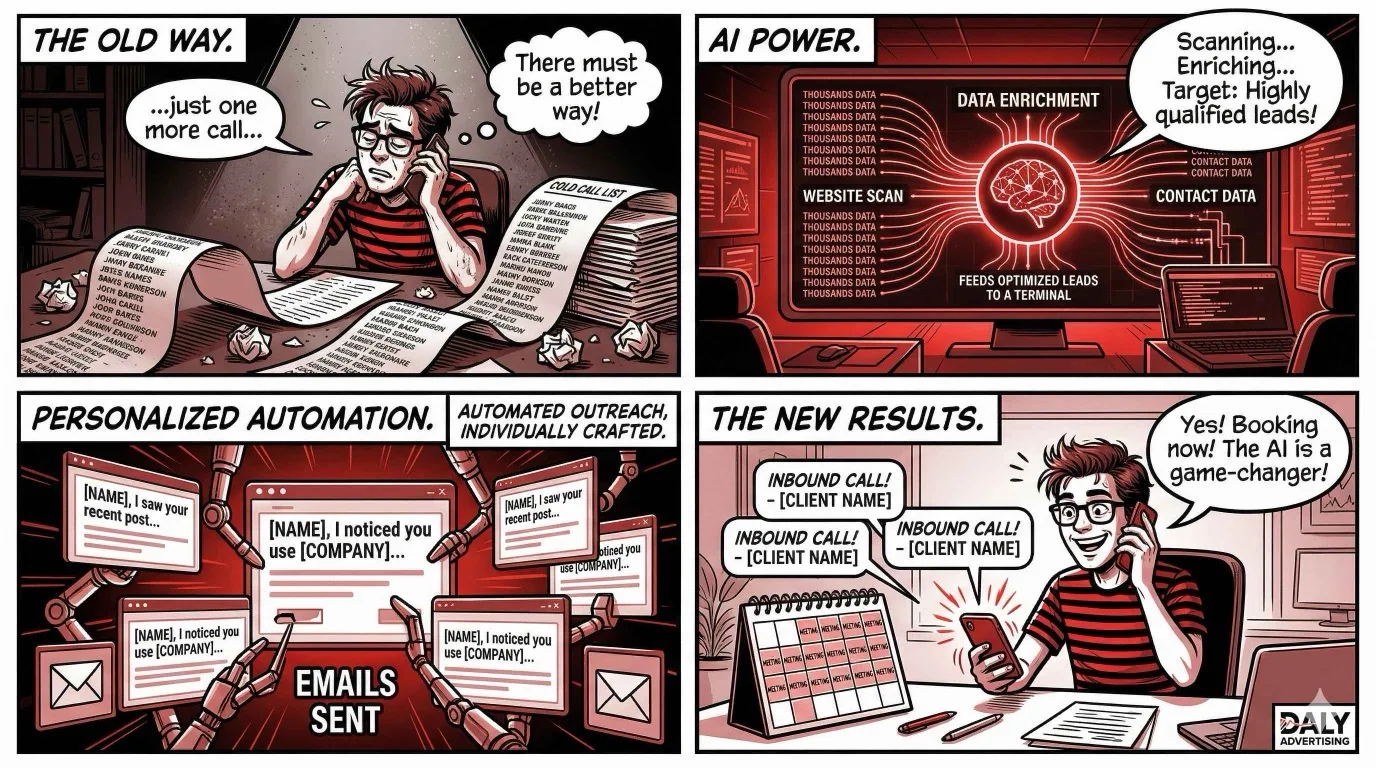
The traditional lead generation playbook is broken. Cold call 200 people, get 5 conversations, close 1 deal. Buy a list, blast 10,000 emails, get 50 replies, book 8 meetings. The math only works if labor is cheap and time is infinite. Neither is true anymore.
AI has fundamentally changed what is possible. Not by replacing the human elements that close deals, but by automating the 80% of lead generation that is pure execution: finding prospects, enriching data, personalizing outreach, qualifying interest, and nurturing relationships. The businesses that have adopted AI-powered lead generation in 2025-2026 are operating at 3-5x the efficiency of their competitors. Not because they are working harder, but because their systems are smarter.
This guide covers what AI lead generation actually looks like in practice. Not theory or hype, but specific tools, workflows, and strategies that are producing measurable results right now. If your pipeline needs more qualified leads without proportionally more headcount, this is the playbook.
What AI Lead Generation Actually Means
When most people hear "AI lead generation," they think of chatbots. Chatbots are part of it, but they are maybe 15% of the picture. AI lead generation is the application of artificial intelligence across the entire lead generation pipeline, from identifying potential customers to converting them into qualified opportunities.
Here is the full pipeline and where AI fits into each stage:
| Pipeline Stage | Traditional Approach | AI-Powered Approach |
|---|---|---|
| Prospecting | Manual research, purchased lists | AI scrapes, enriches, and scores prospects automatically |
| First Contact | Generic cold emails/calls | Hyper-personalized outreach at scale |
| Qualification | SDRs spend hours on calls | AI chatbots and scoring qualify 24/7 |
| Nurturing | Manual follow-ups, drip campaigns | AI-adaptive sequences based on behavior |
| Content Attraction | 1-2 blog posts per month | 10-20 pieces of optimized content monthly |
| Ad Optimization | Manual A/B testing, 5-10 variants | AI generates and tests 50+ variants |
| Pipeline Management | Manual CRM updates, gut-feel prioritization | AI-scored pipeline with automated routing |
The power is in the compounding effect. When AI handles prospecting, personalization, qualification, and nurturing simultaneously, the entire pipeline accelerates. Your sales team receives a steady stream of pre-qualified, pre-nurtured leads instead of raw names.
AI for Prospecting: Finding Leads at Scale
Prospecting is where most lead generation time is wasted. A sales rep researching 50 prospects per day can maybe identify 10 that fit the ICP (ideal customer profile), find contact information for 7 of them, and write personalized outreach to 4. That is 4 prospects per person per day. AI changes the math entirely.
How AI Prospecting Works
Modern AI prospecting systems combine data scraping, enrichment, and scoring into a single pipeline:
- Define your ICP - Feed the system your best customers' attributes: industry, company size, tech stack, growth stage, funding status, geography, job titles of decision-makers.
- Source identification - AI searches LinkedIn, company databases, industry directories, job postings, news mentions, and public filings to identify companies matching your ICP.
- Data enrichment - For each prospect company, AI pulls: key contacts with email addresses, company revenue and headcount, technology stack (using tools like BuiltWith or Wappalyzer data), recent news and trigger events, social media activity.
- Lead scoring - AI scores each prospect based on ICP fit, engagement signals, and timing indicators. A company that just raised funding, is hiring for your buyer persona's department, and uses complementary technology scores higher than a cold match.
- Output - A prioritized list of prospects with complete data, ready for personalized outreach.
A system like this can identify and enrich 500-1,000 prospects per day, compared to the 10-50 a human researcher would produce. The quality is comparable because the AI is applying the same criteria, just at machine speed.
Tools for AI Prospecting
- Clay - The current gold standard for AI-powered prospecting. Clay connects to 100+ data sources, enriches prospect data automatically, and lets you build custom scoring models. Starting at $149/month.
- Apollo.io - Combines a 275M+ contact database with AI-powered search, scoring, and sequencing. More accessible for smaller teams. Plans from $49/month.
- Ocean.io - Specializes in finding lookalike companies. Upload your best customers and Ocean finds similar businesses. Effective for niche B2B targeting.
- Custom solutions - For teams with specific requirements, custom-built prospecting systems using AI APIs and web scraping can outperform any off-the-shelf tool because they are tuned exactly to your ICP and data sources.
Real Numbers
A client of ours in the B2B software space switched from manual prospecting (2 SDRs spending 60% of their time on research) to an AI prospecting system. Results over 90 days:
- Prospects identified per month: 180 (manual) to 2,400 (AI)
- ICP match rate: 45% (manual) to 72% (AI, after scoring threshold)
- Time spent on prospecting: 96 hours/month (2 SDRs) to 8 hours/month (review and refinement)
- Cost per qualified prospect: $28 (manual) to $3.40 (AI)
AI Chatbots: Qualifying Leads 24/7
Your website receives visitors at all hours. Without a qualification mechanism, those visitors browse, maybe fill out a form, and wait for someone to follow up during business hours. By then, 78% of deals go to the vendor who responds first (Harvard Business Review). If your first response takes 24 hours, you have already lost to the competitor who responds in 5 minutes.
AI chatbots solve this by engaging every visitor immediately with intelligent, contextual conversations.
What a Modern AI Chatbot Can Do
Forget the scripted decision-tree chatbots from 2020. Modern AI chatbots powered by large language models can:
- Hold natural conversations - They understand context, handle tangents, and respond in natural language. Visitors often do not realize they are talking to AI.
- Access your knowledge base - The chatbot is trained on your product documentation, pricing, FAQ, case studies, and sales materials. It answers product questions accurately.
- Qualify based on your criteria - The chatbot asks qualifying questions naturally within the conversation: budget, timeline, company size, use case. No awkward "please fill out this form" experience.
- Book meetings directly - When a visitor qualifies, the chatbot accesses your calendar and books a meeting on the spot. No back-and-forth emails.
- Route to the right person - Based on the conversation, the chatbot routes the lead to the appropriate salesperson, support agent, or department.
- Hand off to humans seamlessly - When a conversation exceeds the chatbot's capabilities, it transfers to a human with full conversation context. No "please explain your issue again."
Implementation Considerations
An AI chatbot that generates leads (rather than just answering questions) requires careful design:
- Personality and tone - Match your brand voice. A law firm's chatbot should not sound like a startup's. Define the tone in the system prompt.
- Qualification criteria - Work with your sales team to define what makes a qualified lead. Hard-code these criteria into the chatbot's logic.
- Escalation triggers - Define when the chatbot should hand off to a human: high-value prospects, complaints, complex technical questions, or any time the visitor asks for a person.
- CRM integration - Every chatbot conversation should create or update a CRM record. The lead's qualification data, conversation summary, and interest level should flow directly into your pipeline.
- Analytics - Track conversations started, qualification rate, meetings booked, and leads converted. These metrics tell you if your chatbot is working or just talking.
We design and deploy AI chatbots that are specifically built for lead qualification, not generic customer service. The difference is in the architecture: every conversation path is designed to move toward qualification while providing genuine value to the visitor.
Performance Benchmarks
Based on deployments across our client base, here are realistic benchmarks for AI lead qualification chatbots in 2026:
| Metric | Good | Great | Exceptional |
|---|---|---|---|
| Engagement rate (visitors who interact) | 8-12% | 12-20% | 20%+ |
| Qualification rate (engaged to qualified) | 15-25% | 25-40% | 40%+ |
| Meeting book rate (qualified to booked) | 30-45% | 45-60% | 60%+ |
| Human handoff rate | 20-30% | 10-20% | Under 10% |
| Average response time | Under 10 seconds | Under 5 seconds | Under 2 seconds |
AI Content Generation: Attracting Organic Leads
Content marketing is the most scalable lead generation channel because it compounds. A blog post that ranks on page one of Google will generate leads for years without ongoing cost per click. The problem has always been production speed: creating high-quality, SEO-optimized content consistently requires significant time and expertise.
AI changes the production equation without sacrificing quality, when used correctly.
The Right Way to Use AI for Content
Let us be clear: publishing raw AI-generated content is a terrible strategy. Google's Helpful Content system specifically targets low-quality AI content, and readers can smell it from a mile away. The right approach uses AI as a production accelerator with human editorial oversight:
- Keyword research - Use AI to analyze search volumes, competition, and content gaps in your niche. Identify topics where you can realistically rank and that attract your target buyer.
- Outline generation - AI creates comprehensive outlines based on top-ranking content, "People Also Ask" data, and your unique expertise. Human editors refine the outline.
- First draft - AI generates a detailed first draft following the outline. This draft is 70-80% of the way there but lacks original insight, real examples, and brand voice.
- Human editing - An expert editor adds original insights, real case studies, specific data, brand voice, and the experiential depth that AI cannot replicate. This step is non-negotiable.
- SEO optimization - AI reviews the final draft for keyword placement, internal linking opportunities, meta tags, and schema markup.
- Publication and distribution - AI generates social media posts, email newsletter content, and ad copy from the published article.
This workflow allows a small team to produce 8-12 high-quality, ranking-worthy pieces per month instead of 2-3. The content is still human-authored in the ways that matter (expertise, originality, voice) but AI handles the heavy lifting of research, structure, and initial drafting.
Content Types That Generate Leads
Not all content generates leads equally. Prioritize these formats:
- Comparison posts - "Tool A vs Tool B" posts capture high-intent search traffic. Someone comparing solutions is close to buying.
- How-to guides - Comprehensive guides establish expertise and rank well. Include CTAs for your service throughout.
- Industry reports - Original research and data attract backlinks, media coverage, and qualified traffic from industry professionals.
- Case studies - Prospects searching for proof that your approach works will find these. Include specific results and numbers.
- Templates and tools - Gated or ungated resources (calculators, templates, checklists) attract leads who are actively working on the problem you solve.
AI Email Outreach: Personalization at Scale
Generic cold email is dead. Open rates for templated outreach have dropped below 15% industry-wide, and response rates hover around 1-2%. The reason is simple: everyone is sending the same emails. "I noticed your company..." and "Quick question..." subject lines get deleted on autopilot.
AI-powered outreach is different because it makes genuine personalization scalable.
How AI Email Personalization Works
A typical AI outreach workflow:
- Prospect data ingestion - The system pulls all available data about the prospect: LinkedIn activity, company news, recent hires, tech stack, funding rounds, content they have published or engaged with.
- Personalization signal identification - AI identifies the most relevant connection points between your offering and the prospect's current situation. Did they just launch a new product? Are they hiring for a role your tool supports? Did they write about a challenge you solve?
- Email generation - AI drafts a personalized email that opens with a relevant observation (not flattery), connects it to a specific value proposition, and includes a low-friction CTA. Each email is unique.
- Sequence creation - AI generates a 3-5 email sequence with different angles and escalating urgency. Each follow-up references the previous email and adds new value.
- Quality check - AI reviews each email for spam trigger words, proper formatting, personalization accuracy, and tone consistency.
- Sending and monitoring - Emails are sent through a deliverability-optimized system with proper warmup, domain rotation, and send limits. AI monitors opens, replies, and bounces, adjusting the approach in real time.
Results You Can Expect
AI-personalized outreach consistently outperforms templates by a wide margin:
| Metric | Generic Templates | AI-Personalized | Improvement |
|---|---|---|---|
| Open rate | 12-18% | 45-65% | 3-4x |
| Reply rate | 1-2% | 5-12% | 4-8x |
| Positive reply rate | 0.3-0.8% | 2-5% | 5-10x |
| Meeting book rate | 0.1-0.3% | 1-3% | 5-10x |
| Time per prospect | 2-5 min (manual personalization) | 5-15 seconds (AI + review) | 20-40x faster |
The key insight: AI personalization at 80% quality across 500 prospects beats manual personalization at 95% quality across 25 prospects. Volume with good personalization wins over perfection at low volume.
Tools for AI Email Outreach
- Instantly - Email sending infrastructure with built-in warmup, rotation, and analytics. Best-in-class deliverability. From $30/month.
- Smartlead - Similar to Instantly with additional multi-channel features (email + LinkedIn + SMS). From $39/month.
- Clay + AI - Use Clay for enrichment and AI for email generation, then send through your preferred sending tool. Most flexible approach.
- Custom pipelines - For highest control, build a custom pipeline using AI APIs for personalization and SendGrid or Amazon SES for delivery.
AI Ad Copy: Testing More Variations Faster
Paid advertising is still a critical lead generation channel, especially for short-term pipeline needs. AI transforms your ad testing process by generating variations at a pace no human team can match.
How AI Improves Ad Performance
Traditional ad testing: your team writes 5-10 ad variations, runs them for 2-4 weeks, picks the winner, and iterates. The cycle is slow and the number of variables you can test is limited by human bandwidth.
AI-powered ad testing: AI generates 50-100 variations across headlines, descriptions, CTAs, and angles in minutes. You load them into your ad platform's responsive or dynamic ad format and let the algorithm find winners across audiences. The cycle compresses from weeks to days.
AI is particularly effective at:
- Headline variations - Testing different value propositions, emotional triggers, and specificity levels.
- Audience-specific copy - Generating ad variations tailored to different buyer personas, industries, or pain points.
- Landing page copy - Testing multiple headline and body copy combinations on landing pages to improve conversion rates.
- Competitive positioning - Generating ad copy that positions against specific competitors based on their weaknesses.
One caveat: AI-generated ad copy needs human review. AI can produce copy that is technically correct but tonally off, makes claims you cannot substantiate, or misses compliance requirements. Always have a human approve before anything goes live.
AI CRM Automation: Scoring, Routing, and Follow-Up
Your CRM is the central nervous system of your lead generation operation. AI automation transforms it from a passive database into an active system that scores leads, routes them to the right people, and triggers follow-up actions automatically.
AI Lead Scoring
Traditional lead scoring uses static rules: company size over 50 employees = 10 points, visited pricing page = 20 points, downloaded whitepaper = 15 points. These rules are better than nothing but they are rigid and do not adapt.
AI lead scoring analyzes patterns across your historical data to identify which combinations of attributes and behaviors predict conversion. It might discover that prospects from the manufacturing industry who visit your case studies page and then return within 48 hours have a 3.2x higher close rate, something no human would spot in the data.
Implementing AI lead scoring requires:
- Sufficient historical data - At minimum, 200-500 closed deals with associated lead attributes and behavioral data.
- Clean CRM data - AI models are only as good as the data they train on. Deduplicate, enrich, and clean your CRM before implementing scoring.
- Integration with your website and marketing tools - The scoring model needs behavioral data (page visits, email engagement, content downloads) in addition to firmographic data.
- Regular retraining - Markets change, and your scoring model should adapt. Retrain quarterly based on recent closed-won and closed-lost data.
Automated Lead Routing
AI-scored leads should route automatically to the right person. Build routing logic based on:
- Score threshold - High-score leads go directly to senior reps. Medium-score leads enter nurture sequences. Low-score leads are deprioritized.
- Territory or vertical - Route leads based on geography, industry, or company size to the appropriate specialist.
- Availability and capacity - Distribute leads evenly across your team, factoring in current pipeline size and response time.
- Speed to lead - High-score leads trigger instant notifications (Slack, SMS, email) to ensure sub-5-minute response times.
Automated Follow-Up Sequences
Most leads require 6-8 touches before converting. AI automates the follow-up while keeping it personal:
- Post-meeting follow-up - AI drafts a personalized summary email after every sales call, referencing specific discussion points.
- Re-engagement campaigns - AI identifies stalled leads and triggers re-engagement sequences with fresh angles based on what originally interested them.
- Milestone-based outreach - AI monitors for trigger events (funding round, new hire, product launch) and sends relevant outreach when a stalled lead shows new buying signals.
The combination of scoring, routing, and follow-up automation means no lead falls through the cracks and every prospect receives timely, relevant communication. If you are evaluating how to connect AI with your existing CRM systems, start with scoring and routing before tackling content personalization.
Tools: Building Your AI Lead Generation Stack
Here is a recommended tool stack for each budget level, from scrappy startup to established enterprise:
Starter Stack ($200-500/month)
| Function | Tool | Monthly Cost |
|---|---|---|
| Prospecting + Enrichment | Apollo.io (Basic) | $49 |
| Email Outreach | Instantly (Growth) | $30 |
| AI Personalization | Claude API or GPT API | $50-100 |
| CRM | HubSpot (Free) | $0 |
| Chatbot | Tidio (Free tier) | $0 |
| Automation | Make.com (Core) | $9 |
Growth Stack ($500-2,000/month)
| Function | Tool | Monthly Cost |
|---|---|---|
| Prospecting + Enrichment | Clay (Explorer) | $349 |
| Email Outreach | Instantly (Hypergrowth) | $78 |
| AI Personalization | Claude API + Custom Prompts | $150-300 |
| CRM | HubSpot (Starter) | $20 |
| Chatbot | Custom AI Chatbot | $100-200 |
| Automation | Make.com (Pro) | $16 |
| Content | Claude API + SEO tool | $200-400 |
Enterprise Stack ($2,000-10,000/month)
| Function | Tool | Monthly Cost |
|---|---|---|
| Prospecting + Enrichment | Clay (Pro) + ZoomInfo | $1,000-3,000 |
| Email Outreach | Smartlead or custom infrastructure | $200-500 |
| AI Personalization | Custom AI pipeline | $500-2,000 |
| CRM | HubSpot (Pro) or Salesforce | $500-2,000 |
| Chatbot | Custom AI agent with CRM integration | $300-800 |
| Automation | Custom APIs + n8n (self-hosted) | $100-500 |
| Content | AI-assisted editorial team | $2,000-5,000 |
The right stack depends on your volume, complexity, and in-house technical capability. If you need help designing a stack that fits your specific situation, our AI integration service starts with a full assessment of your current tools and processes.
What Doesn't Work: Common AI Lead Gen Mistakes
For every AI lead generation success story, there are ten failures. Here is what goes wrong and how to avoid it.
Mistake 1: Spray-and-Pray at Scale
AI makes it easy to send 10,000 emails per day. That does not mean you should. Sending mass outreach without tight targeting and genuine personalization will destroy your domain reputation, get you blacklisted, and potentially violate CAN-SPAM or GDPR. The goal is not more volume. It is more relevant volume.
Mistake 2: Generic AI Templates
"I noticed your company is doing great things in [INDUSTRY]" is not personalization. It is a template with a variable. Real personalization references something specific: a recent blog post, a LinkedIn comment, a product launch, a hiring trend. If your AI outreach reads like a template, it will perform like one.
Mistake 3: No Human Oversight
AI hallucinates. It will occasionally reference a company milestone that did not happen, misidentify a person's role, or generate content that is factually wrong. Every AI output that reaches a prospect should be reviewed by a human. The review can be fast (30 seconds per email for a spot check), but it must happen.
Mistake 4: Automating Bad Processes
If your lead qualification criteria are wrong, automating the qualification process will just generate bad leads faster. If your email messaging does not resonate, AI-personalizing bad messaging will not fix it. Before automating, validate that your process works manually. Then automate what works.
Mistake 5: Ignoring Deliverability
AI-generated emails are useless if they land in spam. Email deliverability requires proper domain setup (SPF, DKIM, DMARC), sender warmup, volume management, and clean contact lists. Many teams focus on the AI side and completely neglect deliverability infrastructure, then wonder why their open rates are 8%.
Mistake 6: Over-Automating the Human Moments
Some parts of the sales process should stay human. The discovery call, the needs assessment, the proposal presentation, the negotiation. AI should hand off to humans at the right moment, not try to replace them in high-stakes interactions. The businesses seeing the best results use AI for the 80% that is routine and humans for the 20% that is relationship-driven.
Building Your AI Lead Gen System: A Practical Roadmap
Do not try to build everything at once. Here is a phased approach that builds on each success.
Phase 1: Foundation (Weeks 1-4)
- Define your ICP with specific, measurable criteria
- Clean and enrich your existing CRM data
- Set up email infrastructure (dedicated domain, warmup, authentication)
- Choose your prospecting tool and build your first prospect list
- Write and test your first AI-personalized outreach sequence (start with 50 prospects)
Success metric: Reply rate above 5% on your first sequence.
Phase 2: Scale Outbound (Weeks 5-8)
- Refine your AI personalization based on Phase 1 data
- Scale to 200-500 prospects per week
- Build automated follow-up sequences (3-5 touches)
- Implement lead scoring in your CRM
- Set up automated routing and notifications
Success metric: 10+ qualified meetings booked per month from outbound.
Phase 3: Add Inbound (Weeks 9-16)
- Deploy an AI chatbot on your website for lead qualification
- Launch an AI-assisted content program (4 posts per month minimum)
- Build content-to-lead conversion paths (CTAs, gated resources, chatbot triggers)
- Integrate chatbot data with your CRM and scoring model
Success metric: Chatbot qualifying 5+ leads per week. Content generating organic traffic growth of 20%+ month over month.
Phase 4: Optimize and Expand (Ongoing)
- A/B test outreach angles, subject lines, and CTAs
- Retrain your scoring model with fresh closed-won/closed-lost data
- Add new channels (LinkedIn outreach, paid retargeting, event follow-up)
- Build automated reporting on pipeline attribution
- Continuously refine ICP based on which leads actually close
Success metric: Pipeline growth of 30%+ quarter over quarter with stable or declining cost per qualified lead.
Measuring What Matters
Track these metrics weekly to ensure your AI lead generation system is performing:
| Metric | Why It Matters | Target |
|---|---|---|
| Cost per lead (CPL) | Total lead gen spend / leads generated | Declining quarter over quarter |
| Cost per qualified lead (CPQL) | Total spend / qualified leads | Industry-dependent, but lower than manual |
| Lead-to-meeting rate | Are your leads converting to conversations? | Above 15% for outbound, 25% for inbound |
| Speed to lead | Time from first touch to first human response | Under 5 minutes for high-score leads |
| Pipeline velocity | How fast leads move through your pipeline | Improving quarter over quarter |
| Revenue per lead | Total revenue / leads (by source) | AI-generated leads matching or exceeding manual |
| AI accuracy rate | % of AI outputs requiring zero human correction | Above 85% |
The most important metric is revenue attributed to AI-generated leads. Everything else is a leading indicator. If your AI lead generation system is not ultimately producing revenue, it does not matter how impressive the open rates or meeting counts look.
Getting Started Today
AI lead generation is not a future trend. It is a current competitive advantage that is rapidly becoming a baseline requirement. The businesses that build these systems now will have 12-18 months of compounding data and optimization ahead of their competitors who wait.
Here is the honest assessment: building an effective AI lead generation system requires expertise in AI, data engineering, sales operations, and marketing strategy. You can learn and build it yourself (and this guide gives you the roadmap), or you can work with a team that has already built these systems across dozens of businesses.
We build AI-powered lead generation systems that integrate with your existing tools, respect your brand, and produce measurable pipeline results. Every engagement starts with a free audit of your current lead generation workflows to identify the highest-impact automation opportunities. Request your free audit and we will map out exactly what an AI lead generation system would look like for your business.
The businesses winning in 2026 are not the ones with the biggest sales teams. They are the ones with the smartest systems. AI lead generation is not about replacing your people. It is about giving them superhuman reach.