 DALY
DALY 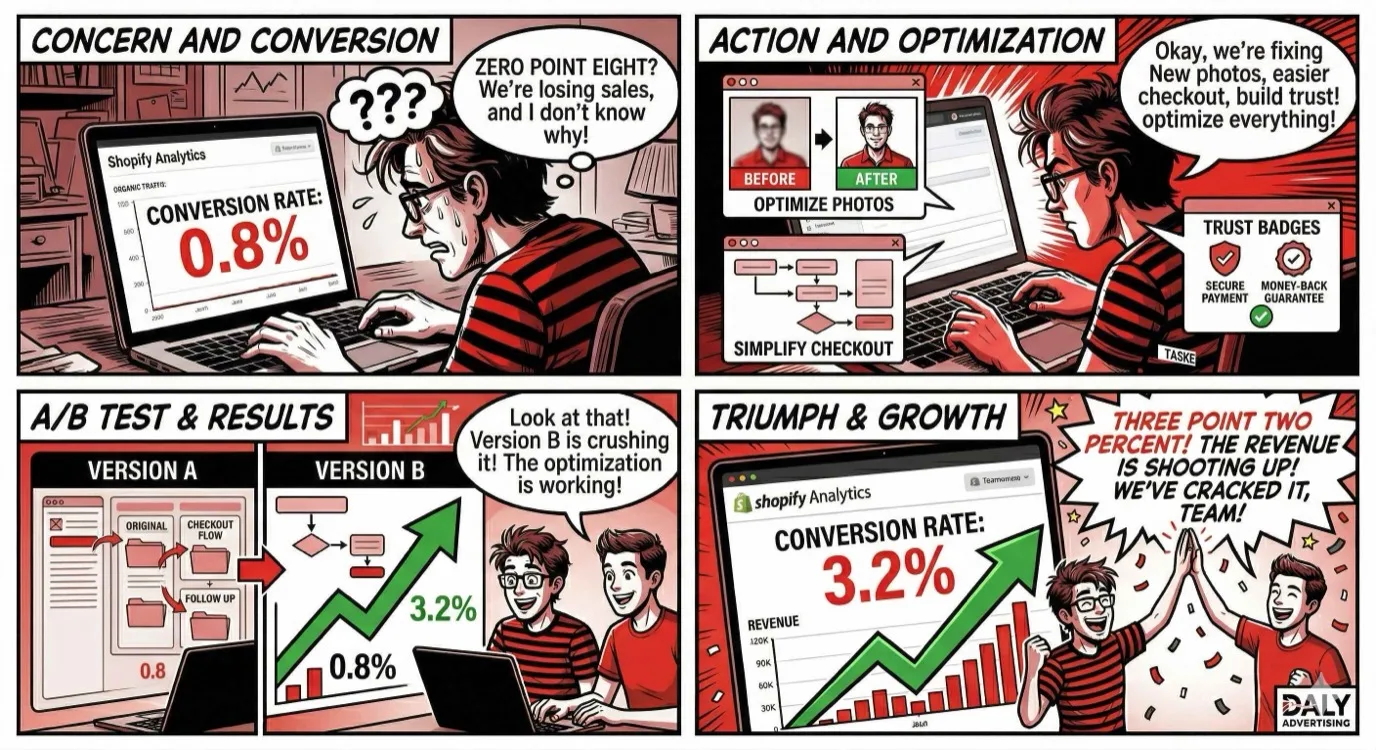
Traffic Is Not Your Problem. Conversion Is.
Most ecommerce store owners are obsessed with traffic. They pour money into ads, SEO, and influencer partnerships to get more visitors. And it works, sort of. The visitors show up, browse a few pages, and leave without buying. Then the store owner's conclusion is always the same: "We need more traffic."
No, you do not. You need a higher conversion rate.
Here is the math that changes everything: a store with 50,000 monthly visitors and a 1.5% conversion rate generates 750 orders per month. If you increase that conversion rate to 2.5% (which is achievable with the changes in this guide), you get 1,250 orders per month. That is a 67% increase in revenue without spending a single extra dollar on traffic.
We optimize ecommerce stores through our ecommerce marketing services, and the pattern is always the same: stores are leaving 30 to 50% of their potential revenue on the table due to fixable conversion issues. These are the 15 changes that consistently move the needle.
Average Ecommerce Conversion Rates by Industry
Before you start optimizing, you need to know where you stand. Here are the 2025/2026 benchmarks:
| Industry | Average Conversion Rate | Top 25% Benchmark |
|---|---|---|
| Food and beverage | 4.6% | 7.2% |
| Health and beauty | 3.3% | 5.8% |
| Fashion and apparel | 2.7% | 4.5% |
| Home and furniture | 1.4% | 2.8% |
| Electronics | 1.9% | 3.4% |
| Pet supplies | 3.1% | 5.2% |
| Sports and outdoors | 2.1% | 3.6% |
| Jewelry and accessories | 1.5% | 2.9% |
If you are below your industry average, the changes below will likely get you to average or above. If you are already at the average, these changes will push you into the top 25%, which is where the real revenue growth happens.
Change 1: Simplify Your Navigation
Every click between your homepage and the "Add to Cart" button is a point where customers drop off. The average ecommerce site requires 4.2 clicks to reach a product page. Top-performing stores average 2.1 clicks.
Here is what to fix:
- Reduce your main navigation to 5 to 7 items. No mega-menus with 40 links. If you have many categories, use a well-organized dropdown, not a wall of text.
- Add a persistent search bar. 30% of ecommerce visitors use site search, and they convert at 2 to 3x the rate of browsers. Make search prominent, not hidden behind an icon.
- Feature your bestsellers. Put your top 5 to 10 products one click from the homepage. Most of your revenue comes from 20% of your products, so make those ridiculously easy to find.
- Remove dead-end pages. Every page should lead somewhere productive. If a category page has no products in stock, redirect it or feature alternative products.
Expected lift: 5 to 15% increase in pages-per-session and a 3 to 8% improvement in conversion rate for stores with currently complex navigation.
Change 2: Optimize the Product Page Above the Fold
The first thing a customer sees on your product page determines whether they scroll or bounce. Above the fold, before any scrolling, the customer needs to see:
- The product image (large, high-quality, showing the product in use)
- The product name (clear, descriptive, not clever)
- The price (including any savings if on sale)
- Star rating and review count (social proof)
- The Add to Cart button (visible without scrolling on both desktop and mobile)
- Shipping information (free shipping threshold or delivery estimate)
That is it. Everything else, detailed descriptions, specifications, reviews, related products, goes below the fold. The above-the-fold area is for decision-making, not information gathering.
A common mistake on Shopify stores is burying the Add to Cart button below a long product description. Move it up. Make it sticky on mobile so it follows the customer as they scroll.
Expected lift: 8 to 20% increase in add-to-cart rate.
Change 3: Invest in Product Photography
Your customers cannot touch your product. They cannot hold it, feel its weight, or see how it catches the light. Photography is the closest substitute, and most ecommerce stores are not doing it justice.
The minimum standard for 2026:
- 6 to 8 images per product. White background shots from multiple angles, lifestyle shots showing the product in context, detail shots for texture and quality, and a size reference shot.
- Video. Even a 15-second product video increases conversion by 20 to 40%. It does not need to be cinematic. A well-lit, steady shot of the product being used is enough.
- Zoom capability. Let customers zoom into product details. This is especially important for fashion, jewelry, and home decor.
- User-generated content. Real photos from real customers convert better than professional shots for many product categories. Feature them prominently.
Expected lift: 15 to 40% increase in conversion rate for stores upgrading from basic to professional product imagery.
Change 4: Strategic Social Proof Placement
Social proof is not just about having reviews. It is about putting the right type of social proof in the right place at the right time in the buying journey.
Product Pages
- Star rating and review count immediately visible (above the fold)
- Full reviews below the product description with filtering by rating
- Photo reviews surfaced first (they convert 2x better than text-only reviews)
- "X people bought this in the last 24 hours" counter (if real, never fake)
Cart and Checkout
- Trust badges: SSL, payment processor logos, money-back guarantee
- A single compelling testimonial focused on reliability or quality
- "Trusted by X,000 customers" line
Throughout the Site
- Press logos (if applicable): "As seen in..."
- Instagram feed showing real customers using products
- Case studies or before/after for applicable products
Expected lift: 10 to 25% increase in conversion rate when social proof is properly placed versus missing or poorly positioned.
Change 5: Cart Abandonment Recovery
The average cart abandonment rate across ecommerce is 70.2%. That means for every 10 customers who add a product to their cart, 7 leave without buying. Recovering even a fraction of those abandoned carts has an enormous impact on revenue.
The most effective cart abandonment recovery sequence:
| Timing | Channel | Message | Expected Recovery Rate |
|---|---|---|---|
| 1 hour | "You left something behind" + product image + direct cart link | 8 to 12% | |
| 4 hours | SMS | Short, casual: "Still thinking about [product]? Here's your cart: [link]" | 5 to 8% |
| 24 hours | Social proof angle: reviews of the abandoned product + subtle urgency | 4 to 7% | |
| 48 hours | Incentive: 10% off or free shipping if margin allows | 3 to 5% | |
| 72 hours | SMS | Last chance: "Your cart expires soon" | 2 to 3% |
Combined, a well-built abandonment sequence recovers 15 to 25% of abandoned carts. For a store abandoning $50,000 per month in carts, that is $7,500 to $12,500 in recovered revenue, monthly.
Expected lift: 8 to 15% increase in overall store revenue from cart recovery alone.
Change 6: Simplify Your Checkout
The Baymard Institute analyzed over 100 ecommerce checkouts and found that the average checkout has 14.88 form fields. The optimal number? 7 to 8. Every unnecessary field increases abandonment.
Here is the checkout optimization checklist:
- Guest checkout. 24% of shoppers abandon because they are forced to create an account. Offer guest checkout as the default, with an option to create an account after purchase.
- Auto-fill everything. Address auto-complete (Google Places API), saved payment methods, and auto-detected city/state from zip code.
- Single page checkout. Multi-step checkouts are not inherently bad, but single-page checkouts consistently outperform them by 5 to 12% in testing.
- Show order summary. Customers want to see what they are buying without going back. Keep a visible order summary with product images.
- Progress indicator. If you must use multi-step, show exactly where the customer is in the process.
- No surprise costs. The number one reason for checkout abandonment (48%) is unexpected shipping, tax, or fee costs. Show the total cost as early as possible.
Expected lift: 10 to 25% reduction in checkout abandonment.
Change 7: Mobile-First Design
In 2026, mobile accounts for 63% of ecommerce traffic and 55% of revenue. Yet most stores are still designed on desktop and then adjusted for mobile as an afterthought. This is backwards.
Mobile-specific optimizations that matter:
- Thumb-friendly buttons. CTA buttons should be at least 48px tall and positioned where thumbs naturally rest (bottom third of the screen).
- Sticky Add to Cart. As users scroll through product details, the purchase button should remain accessible.
- Tap-to-expand sections. Instead of long scrolling pages, use accordions for product details, shipping info, and reviews.
- One-tap payment. Apple Pay and Google Pay should be the first payment options shown on mobile. They reduce checkout time from 2+ minutes to under 10 seconds.
- Image optimization. Mobile users on cellular connections need images that load in under 1 second. Use next-gen formats (WebP, AVIF) and lazy loading.
- Font size. Body text at 16px minimum. Anything smaller causes zooming, which causes frustration, which causes bouncing.
Expected lift: 15 to 30% improvement in mobile conversion rate, which significantly impacts overall revenue given mobile's traffic share.
Change 8: Site Speed Optimization
Google's data shows that as page load time goes from 1 second to 3 seconds, the probability of bounce increases by 32%. From 1 to 5 seconds? Bounce probability increases by 90%.
For ecommerce specifically, a 1-second improvement in load time increases conversions by 7% on average. Here is where to focus:
| Optimization | Typical Impact | Difficulty |
|---|---|---|
| Image compression and next-gen formats | 30 to 50% faster load | Easy |
| Reduce third-party scripts (apps, tracking pixels) | 20 to 40% faster load | Medium |
| Enable browser caching | 10 to 20% faster for return visitors | Easy |
| CDN (Content Delivery Network) | 15 to 30% faster globally | Easy |
| Lazy load below-the-fold content | 20 to 40% faster initial load | Easy |
| Code minification (CSS, JS) | 5 to 15% faster load | Easy |
| Remove unused apps/plugins | 10 to 30% faster load | Easy |
The biggest offenders on Shopify stores are usually unoptimized apps. We regularly audit stores that have 15 to 20 installed apps, each adding JavaScript, and the store takes 6+ seconds to load. Remove anything you are not actively using. Every app has a performance cost.
Expected lift: 5 to 15% improvement in conversion rate for stores improving load time from 4+ seconds to under 2.5 seconds.
Change 9: Clear Shipping and Return Policies
Uncertainty kills conversions. When a customer does not know how much shipping costs, when their order will arrive, or what happens if they do not like it, they default to not buying.
Make these three things crystal clear on every product page:
- Shipping cost and timeline. "Free shipping on orders over $50. Standard delivery in 3 to 5 business days. Express available for $9.99 (1 to 2 days)."
- Return policy. "30-day hassle-free returns. Free return shipping. Full refund, no questions asked." If your policy is restrictive, at least be transparent about it.
- Guarantee. A satisfaction guarantee, even if it is just restating your return policy with more confident language, reduces perceived risk.
Position this information near the Add to Cart button, not buried in a footer link. We have tested this repeatedly: moving shipping and return info above the fold on product pages increases add-to-cart rates by 8 to 14%.
Expected lift: 5 to 12% increase in conversion rate.
Change 10: Urgency and Scarcity, Done Right
Let us be clear: fake scarcity is unethical and increasingly illegal. "Only 2 left!" when you have 2,000 in your warehouse is deceptive. Customers and regulators are catching on.
Real urgency and scarcity, though, is one of the most powerful conversion tools available:
- Genuine limited stock. If you actually have low inventory, say so. "12 remaining" is a factual statement that creates urgency.
- Time-limited promotions. Real sales with real end dates. A countdown timer is effective when the sale actually ends when the timer hits zero.
- Seasonal relevance. "Order by December 18 for guaranteed Christmas delivery" is urgency based on a real constraint.
- Social proof urgency. "47 people are viewing this right now" or "Purchased 23 times in the last 24 hours" (only if true).
The principle: urgency based on real constraints converts. Urgency based on manipulation erodes trust and leads to returns, chargebacks, and one-star reviews.
Expected lift: 3 to 10% increase in conversion rate with legitimate urgency tactics.
Change 11: Strategic Upsell and Cross-Sell
Increasing average order value (AOV) has the same effect on revenue as increasing conversion rate, sometimes more. And it is often easier to convince someone who is already buying to spend more than to convince a new visitor to buy at all.
The three types that work:
Product Page Cross-Sells
"Frequently bought together" bundles shown on the product page. Amazon attributes 35% of its revenue to this feature. For smaller stores, 8 to 15% of revenue from cross-sells is realistic.
Cart Upsells
After adding to cart, offer a complementary product at a discount: "Add [product] for 20% off." This works best when the suggested product is directly related and priced at 25 to 35% of the original item.
Post-Purchase Upsells
After checkout but before the confirmation page, offer a one-click add-on. The customer has already committed and entered payment info, so the friction to add another item is minimal. Conversion rates on post-purchase upsells run 8 to 15%.
Expected lift: 10 to 25% increase in average order value.
Change 12: Multiple Payment Options
If a customer cannot pay the way they want, they will find a store where they can. The payment landscape in 2026 demands flexibility:
| Payment Method | Why It Matters | Expected Impact |
|---|---|---|
| Credit/debit cards | Still the default for most shoppers | Baseline |
| Apple Pay / Google Pay | 1-tap checkout on mobile | +12 to 18% mobile conversion |
| Buy Now, Pay Later (Klarna, Afterpay, Affirm) | Makes higher-priced items accessible | +15 to 30% AOV on $100+ products |
| PayPal | Trust factor for first-time buyers | +5 to 10% conversion |
| Shop Pay (Shopify) | Accelerated checkout for returning buyers | +10 to 18% conversion |
Buy Now, Pay Later deserves special attention. For stores selling products over $100, BNPL can increase conversion by 20 to 30% in that price range. Customers who use BNPL also tend to have higher AOV and lower return rates than expected, because the smaller payments reduce buyer's remorse.
Expected lift: 5 to 15% overall conversion increase from offering comprehensive payment options.
Change 13: Exit Intent Offers
Exit intent technology detects when a visitor is about to leave (mouse moving toward the browser's close button on desktop, or back-button behavior on mobile) and shows a targeted offer.
The offers that work best, ranked by effectiveness:
- Free shipping threshold. "You're $12 away from free shipping!" (works when the visitor has items in cart)
- Percentage discount. "Wait, here's 10% off your first order" with an email capture (works for new visitors)
- Content offer. "Download our [product category] buying guide" with email capture (works for research-phase visitors)
- Reminder. "Your cart is saved! We'll email you a link" (works for mobile visitors who might return on desktop)
Important: show exit intent popups once per session, maximum. Showing them repeatedly is annoying and damages brand perception. Also exclude customers who are navigating normally (going to another page on your site) from returning customers who have already purchased.
Expected lift: 3 to 8% recovery of abandoning visitors, which translates to a 2 to 5% overall conversion improvement.
Change 14: Product Recommendation Engine
Generic "You might also like" sections with random products do nothing. Intelligent product recommendations based on browsing behavior, purchase history, and collaborative filtering (what similar customers bought) are a different story.
Where to place recommendations:
- Homepage: "Trending now" and "New arrivals" for cold visitors. "Recommended for you" and "Based on your last visit" for returning visitors.
- Product pages: "Customers who bought this also bought" and "Complete the look" for fashion, or "Compatible accessories" for electronics.
- Cart page: "Don't forget" suggestions for complementary items.
- Post-purchase emails: "Based on your recent purchase, you might love these" sent 7 to 14 days after delivery.
- 404 pages: Instead of a dead end, show bestsellers and a search bar.
Shopify apps like Rebuy, LimeSpot, and Nosto handle this well. For custom stores, collaborative filtering algorithms are available through cloud ML services. The ROI is substantial: stores with personalized recommendations generate 10 to 30% of their revenue from recommended products.
Expected lift: 5 to 15% increase in revenue per visitor.
Change 15: Build an A/B Testing Framework
Every change above comes with an "expected lift" range. The actual impact on your specific store depends on your audience, products, price points, and dozens of other variables. The only way to know what works for you is to test.
An A/B testing framework is not optional for serious ecommerce. Here is how to build one:
Tools
- Free: Google Optimize (sunset, but alternatives like Optimizely's free tier or VWO's starter plan work)
- Paid: VWO, Optimizely, or Convert.com ($100 to $500/month depending on traffic)
- Shopify-native: Shoplift, Neat A/B Testing
What to Test First
- Product page layout (above the fold content and CTA placement)
- Checkout flow (single page vs. multi-step)
- Homepage hero (value proposition messaging)
- Pricing display (showing savings vs. just the price)
- Social proof placement and format
Testing Discipline
- Test one variable at a time
- Run tests for a minimum of 2 full business cycles (usually 2 to 4 weeks)
- Require 95% statistical significance before declaring a winner
- Document every test: hypothesis, variant, result, and what you learned
- Do not end tests early because one variant "looks like it's winning"
Expected lift: Stores with active testing programs improve conversion rate by 20 to 50% over 12 months through compounding incremental gains.
Measuring CRO Impact: Revenue Per Visitor, Not Just Conversion Rate
Conversion rate is an incomplete metric. A store could increase conversion rate by 50% with a permanent 40% off sale, but that would destroy profitability. The metric that actually matters is revenue per visitor (RPV).
RPV = Total Revenue / Total Visitors
RPV accounts for conversion rate, average order value, and return rates in a single number. It is the truest measure of how well your store converts traffic into money.
Here is how the metrics relate:
| Scenario | Conversion Rate | AOV | RPV | Monthly Revenue (50K visitors) |
|---|---|---|---|---|
| Before CRO | 1.5% | $85 | $1.28 | $63,750 |
| After CRO (conversion focus) | 2.5% | $85 | $2.13 | $106,250 |
| After CRO (conversion + AOV) | 2.5% | $105 | $2.63 | $131,250 |
The third scenario, optimizing both conversion rate and AOV, generates $67,500 more per month than the unoptimized store. That is an additional $810,000 per year from the same traffic.
Prioritization Framework: Effort vs. Impact Matrix
You cannot implement all 15 changes at once. Use this matrix to decide what to tackle first:
| Low Effort (1 to 3 days) | High Effort (1 to 4 weeks) | |
|---|---|---|
| High Impact | Checkout simplification, Mobile optimization, Shipping/return clarity, Payment options | Product photography, Cart abandonment recovery, Recommendation engine |
| Medium Impact | Social proof placement, Exit intent offers, Urgency tactics, Navigation simplification | A/B testing framework, Upsell/cross-sell system, Above-the-fold optimization, Site speed overhaul |
Start in the top-left quadrant: high impact, low effort. These are the changes that generate the fastest ROI. Then move to high impact, high effort. Leave medium-impact items for after your foundation is solid.
What to Do Next
If you have read this far, you know your store has room to grow. The question is not whether these changes work, the data is clear, the question is which ones will have the biggest impact on your specific store.
That depends on where your current bottlenecks are. Is it the product page? The checkout? Mobile experience? Without analyzing your specific data, you are guessing.
We optimize ecommerce stores for maximum revenue per visitor through our ecommerce web design and optimization services. Every engagement starts with a data-driven audit that identifies exactly where you are losing customers and what to fix first.
Want to know where your store is leaking revenue? We audit ecommerce stores and deliver a prioritized list of CRO improvements with projected revenue impact. Request a free audit and find out how much revenue your store is leaving on the table.