 DALY
DALY 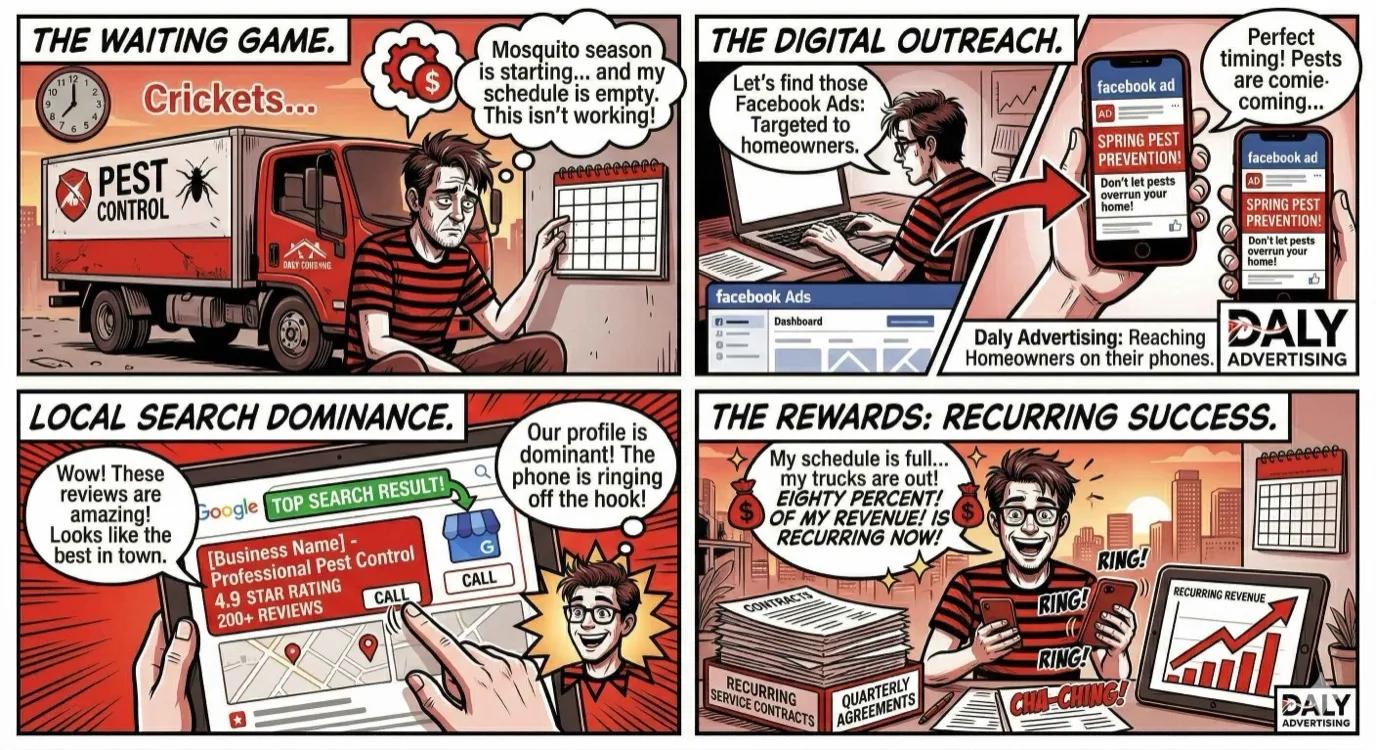
Pest control is one of the most competitive home service industries in digital marketing. Every company in your area is bidding on the same keywords, chasing the same reviews, and running the same "free inspection" offers. The pest control companies that consistently fill their schedules are the ones that build a marketing system, not just run ads when business slows down.
What makes pest control marketing different from other home services? The demand is highly seasonal, the emergency calls are urgent, and the real money is in recurring service plans, not one-time treatments. A marketing strategy that only focuses on new customer acquisition is leaving the most profitable part of the business on the table.
Here are seven strategies that actually generate leads and fill schedules for pest control companies in 2026, along with the specific tactics, costs, and metrics you need to execute each one.
Strategy 1: Google Ads for Emergency and Seasonal Pests
Google Search Ads are the fastest way to generate pest control leads. When someone types "exterminator near me" or "termite treatment cost," they have an active problem and they want it solved today. Your ad at the top of that search result is the most direct path from problem to booked job.
Keywords by Pest Type and Season
Pest control keywords break down into three categories, and each one has different cost, volume, and seasonal patterns.
Emergency and general pest control keywords include terms like "pest control near me," "exterminator near me," "bug exterminator," and "pest removal service." These are high-volume, year-round keywords with strong intent. Cost per click typically ranges from $8 to $25 depending on your market.
Pest-specific keywords are where the real opportunity lives. "Termite treatment," "bed bug exterminator," "rodent control," "roach exterminator," and "ant removal" all target homeowners dealing with a specific pest. These keywords have clear seasonal patterns. Ant and spider searches spike in spring. Mosquito searches peak in summer. Rodent searches surge in fall as temperatures drop. Termite searches are highest in spring through early summer.
Seasonal campaign strategy: Instead of running the same Google Ads campaigns year-round, adjust your keyword focus and budget monthly to match the pests that are active in your region. This approach reduces wasted spend and increases relevance, which improves both click-through rates and quality scores.
Cost Per Lead Benchmarks
Across the pest control campaigns we manage, here are the typical cost per lead ranges by service type:
| Service Type | Avg. Cost Per Click | Conversion Rate | Cost Per Lead |
|---|---|---|---|
| General pest control | $10 - $20 | 6% - 12% | $35 - $80 |
| Termite treatment | $15 - $35 | 5% - 10% | $60 - $150 |
| Bed bug treatment | $12 - $30 | 7% - 13% | $40 - $100 |
| Rodent control | $8 - $18 | 8% - 14% | $30 - $70 |
| Mosquito/tick treatment | $6 - $15 | 5% - 10% | $25 - $60 |
Termite leads are the most expensive but carry the highest job value, often $1,000 to $3,000+ per treatment. General pest control leads are cheaper but lower ticket. The important metric is cost per acquired customer relative to the lifetime value of that customer, which brings us to Strategy 4.
Strategy 2: Google Business Profile Optimization
Your Google Business Profile (GBP) is one of the most valuable free marketing assets your pest control company has. It appears in the local map pack when someone searches for pest control in your area, and it feeds data to both organic search results and Local Services Ads.
Reviews: The Single Most Important Factor
Review count and average rating are the strongest ranking signals for the local map pack. Pest control companies with 100+ reviews and a 4.7+ rating dominate local search in most markets. Strategies 5 covers review generation in detail, but the key point here is that every other GBP optimization effort is secondary to getting more high-quality reviews.
Photos and Visual Content
Businesses with photos on their GBP receive 42% more requests for directions and 35% more website clicks than those without. For pest control, upload photos of your team (uniformed and professional), your vehicles (branded and clean), and your equipment. Do not upload pest photos, as those tend to reduce engagement. Upload 5 to 10 new photos per quarter to signal an active, maintained profile.
Google Posts
Google Posts appear directly on your GBP and give you a way to promote offers, share content, and highlight services. Post weekly about seasonal pest tips, special offers, and service highlights. Posts expire after 7 days, so consistency matters. Companies that post regularly see 15% to 25% more profile views than those that do not.
Q&A Section
The Q&A section on your GBP is an underused opportunity. Seed it with common customer questions and provide thorough answers. "How much does pest control cost?" "Do you offer free inspections?" "Are your treatments safe for pets?" This pre-answers objections and signals expertise to both Google and potential customers.
Local Pack Ranking Factors
Beyond reviews, the key ranking factors for the pest control local pack are:
- Proximity: How close your listed address is to the searcher (you cannot control this)
- Relevance: How well your profile matches the search query (optimize your categories and services)
- Prominence: Your overall online presence, including reviews, citations, backlinks, and website authority
- Engagement signals: Click-through rate, calls from GBP, direction requests, and photo views
Strategy 3: Facebook Ads for Awareness and Seasonal Campaigns
Facebook advertising works differently for pest control than Google. On Google, you capture demand that already exists. On Facebook, you create awareness and urgency before the homeowner has a visible pest problem. This makes Facebook ideal for seasonal campaigns and preventive service offers.
Targeting Homeowners Before Pest Season
The most effective Facebook ad strategy for pest control is running seasonal awareness campaigns 30 to 60 days before peak pest activity in your area. Target homeowners within your service area with messaging about upcoming pest seasons and what they can do to prevent infestations.
For example, in February and March, run campaigns targeting homeowners about spring ant and termite season. In May, shift to mosquito and tick prevention. In September, transition to rodent exclusion messaging. This approach positions your company as the expert and generates leads before your competitors ramp up their advertising.
Creative That Performs: Educational Content
Pest control Facebook ads that educate outperform those that sell directly. Content like "5 signs you might have termites in your home" or "Why you are seeing more spiders this fall" generates higher engagement, more shares, and lower cost per lead than a straightforward "Call us for pest control" ad.
The format matters too. Short video (30 to 60 seconds) with a technician explaining a pest-related topic outperforms static images by 2x to 3x in our testing. The video does not need to be professionally produced. A technician speaking to camera from a customer's property with genuine expertise reads as authentic and trustworthy.
Carousel ads showing different pest types and treatments also work well, especially for general pest control services. Each card in the carousel addresses a different pest with a specific message: "Ants: free inspection, same-day treatment," "Spiders: interior and exterior treatment, $99," and so on.
Typical Facebook Costs for Pest Control
Facebook leads for pest control are generally cheaper than Google leads but require stronger follow-up because the intent is lower:
- Seasonal prevention campaigns: $12 to $30 per lead
- Free inspection offers: $15 to $35 per lead
- Specific pest treatment campaigns: $20 to $50 per lead
- Recurring plan promotions: $18 to $40 per lead
The key to making Facebook leads profitable is speed of follow-up. Pest control Facebook leads should be called within 5 minutes of submission. Every additional hour of delay reduces conversion rates by roughly 10%.
Strategy 4: Recurring Service Plans (The Real Money)
This is the strategy that separates pest control companies that struggle from those that thrive. One-time pest control treatments generate revenue, but recurring service plans generate wealth. The math is not even close.
The Economics of Recurring vs. One-Time
A one-time pest control customer is worth $150 to $300 in immediate revenue. They call when they have a problem, you treat it, and you may never hear from them again unless another problem occurs.
A recurring plan customer on a quarterly service (the most common frequency) pays $40 to $60 per treatment, or $160 to $240 per year. That sounds similar to a one-time customer, but the differences are critical:
- Predictable revenue: You know exactly how much recurring revenue comes in each month
- Lower acquisition cost: You acquire the customer once and retain them for years
- Higher lifetime value: The average recurring pest control customer stays for 3 to 5 years, generating $500 to $1,200 in total revenue
- Route density: Recurring customers in the same neighborhoods create efficient service routes, reducing drive time and increasing daily job capacity
- Referral source: Recurring customers are your best source of referrals because they interact with your brand regularly
How to Market Recurring Plans
Recurring plans need their own marketing approach. Here is what works:
Name the plan: "Quarterly Pest Protection Plan" or "Year-Round Pest Shield" sounds more valuable than "4 visits per year." Branding the plan makes it feel like a product, not just a service schedule.
Lead with benefits, not frequency: Homeowners do not care about 4 visits per year. They care about a pest-free home, guaranteed. Frame the plan around outcomes: "No pests, guaranteed, or we re-treat for free" is more compelling than "Quarterly interior and exterior treatment."
Price it accessibly: Monthly pricing ($29/month or $39/month) feels more accessible than annual pricing ($348/year or $468/year), even though it is the same cost. Offer both options and watch how many choose monthly.
Add exclusivity: Priority scheduling, free re-treatments between visits, discounts on specialty services (termite, mosquito), and a free annual termite inspection for plan members all add perceived value without significant cost to your business.
Converting One-Time Customers to Recurring
Your existing one-time customers are the warmest audience for recurring plan sales. They already know and trust your service. Converting them requires a systematic approach:
- At the point of service: Train technicians to explain the recurring plan after every job. "I treated the problem today, but it is likely to come back in 2 to 3 months. Our quarterly plan prevents that for $39/month."
- 7 days post-service email: Send an automated email thanking them for their business and offering the recurring plan with a first-month discount.
- 30 days post-service SMS: "Hi [name], just checking in on the treatment we did last month. Everything pest-free? Reply YES to lock in our quarterly plan at a 15% discount."
- Seasonal re-engagement: 60 to 90 days after a one-time service, send an email tied to the upcoming pest season: "Spring ant season is starting. Lock in protection before the rush."
Pest control companies that implement this full nurture sequence convert 15% to 25% of one-time customers into recurring plan members. Without it, the conversion rate is typically under 5%. This is where CRM automation becomes essential.
Strategy 5: Review Generation on Autopilot
Reviews are the currency of trust in pest control marketing. They influence Google rankings, ad click-through rates, conversion rates on your website, and the customer's final decision between you and the competitor. The pest control company with the most and best reviews in a market has an unfair advantage across every marketing channel.
Automated Review Requests via CRM
Manual review requests do not scale. You need an automated system that sends a review request after every completed job without requiring your technicians or office staff to remember. Here is the system:
- Job completion triggers the request: When a job is marked complete in your CRM or field service software, an automated SMS and email are sent to the customer
- Timing matters: Send the first request 1 to 2 hours after the job is completed. The experience is fresh, and the customer is most satisfied at this point
- Make it easy: The message should contain a direct link to your Google review page, not your website, not a generic "leave us a review" page, but a link that opens the review form directly
- Follow up once: If no review is left after 3 days, send one follow-up message. Do not send more than that
Companies that implement this automated approach see 15% to 25% of customers leave a review. Without automation, the rate is typically 2% to 5%. For a company doing 200 jobs per month, that is the difference between 4 new reviews and 40 new reviews.
Responding to Reviews for SEO
Every review deserves a response, positive or negative. Google has confirmed that responding to reviews is a factor in local search rankings. Beyond the SEO benefit, responses show potential customers that you are attentive and professional.
For positive reviews, thank the customer by name, mention the specific service if possible, and keep it brief. For negative reviews, respond professionally, acknowledge the concern, and offer to resolve it offline. Never argue in a public review response. The response is not just for the reviewer. It is for every future customer who reads it.
Strategy 6: Local SEO and Content
Organic search is the only marketing channel that compounds over time. Every dollar you invest in local SEO and content today continues generating leads months and years from now with no additional spend. For pest control companies, the two highest-value organic strategies are city-specific landing pages and pest-specific blog content.
City-Specific Landing Pages
If you serve multiple cities or neighborhoods, you need a dedicated landing page for each one. "Pest Control in [City Name]" pages rank for local searches that your homepage cannot. Each page should include:
- The city name in the title, H1, and meta description
- Unique content about pest control in that specific area (common pests, local conditions, climate factors)
- Your local phone number and service address (or nearest service area)
- Reviews from customers in that city
- A clear call to action for scheduling service
Do not copy and paste the same content with the city name swapped. Google penalizes thin, duplicate content. Each page needs genuinely unique content, even if the overall structure is similar.
Blog Content About Pest Types in Your Area
Blog content serves two purposes for pest control SEO: it captures long-tail search traffic and it builds topical authority that strengthens your entire site's rankings.
The most effective pest control blog topics target informational searches that indicate a potential customer:
- "How to get rid of [pest type] in [region/city]"
- "Signs of [pest type] infestation"
- "Are [pest type] dangerous?"
- "How much does [pest type] treatment cost?"
- "What attracts [pest type] to your home?"
Each blog post should end with a clear connection to your services. The reader came looking for information. Give them that information generously, then offer your professional service as the solution. Content that is genuinely helpful builds trust, and trust converts to calls.
Publish 2 to 4 blog posts per month, timed to the seasonal pest calendar. Write about spring pests in February. Write about summer pests in April. This gives the content time to index and rank before the search volume peaks.
Strategy 7: Referral Program
Referral leads convert at the highest rate of any marketing channel, typically 40% to 60%, because they come with built-in trust. The referring customer has already endorsed your service. A structured referral program turns this organic behavior into a predictable lead source.
Incentive Structures That Work
The best pest control referral incentives are simple and valuable enough to motivate action without being so generous that they attract referrals who are not genuine:
- Cash or account credit: $25 to $50 credit on the referring customer's next service for each referral that becomes a customer. This is the simplest and most effective incentive
- Free service upgrade: A free interior treatment or a free add-on service (mosquito treatment, rodent exclusion) for referring customers
- Tiered rewards: 1 referral gets a $25 credit, 3 referrals get a free quarterly service, 5 referrals get a year of free service. This motivates repeat referrals
- Double-sided incentive: The referrer gets $25 off and the new customer gets $25 off their first service. This gives the referrer something tangible to offer their friend or neighbor
Tracking Referrals in Your CRM
A referral program without tracking is just a discount program. You need to know who referred whom, when, and whether the referred lead converted. Your CRM should have a referral source field on every new lead. When a referred lead books, the system should automatically apply the incentive to the referring customer's account.
Promote the referral program through three channels:
- Post-service communication: Include a referral program mention in every post-service email and the technician's closing script
- Recurring plan members: Send a quarterly email to plan members specifically about the referral program. These customers are your most loyal and most likely to refer
- Physical referral cards: Give technicians branded referral cards to hand to customers. A physical card is a tangible reminder that an email cannot replicate
Well-run pest control referral programs generate 10% to 20% of total new customers. At zero media cost, these are your most profitable leads.
Seasonal Marketing Calendar for Pest Control
Pest control demand follows a predictable seasonal pattern. Aligning your marketing to this calendar ensures you are promoting the right services at the right time and ramping spend before demand peaks, not after.
| Month | Primary Pests | Marketing Focus | Ad Budget |
|---|---|---|---|
| January | Rodents, spiders (indoor) | Rodent exclusion, annual plan renewals | Low |
| February | Rodents, termites (early) | Termite awareness campaigns, pre-spring content | Low to medium |
| March | Ants, termites, spiders | Spring campaign launch, Google Ads ramp-up | Medium |
| April | Ants, termites, mosquitoes (early) | Peak spring push, Facebook seasonal campaigns | High |
| May | Ants, mosquitoes, ticks, termites | Mosquito and tick programs launch | High |
| June | Mosquitoes, ticks, ants, wasps | Peak season, maximum ad spend | Maximum |
| July | Mosquitoes, ticks, wasps, fleas | Peak season, flea campaigns for pet owners | Maximum |
| August | Mosquitoes, wasps, spiders | Late summer push, back-to-school pest prevention | High |
| September | Spiders, rodents (early), stink bugs | Fall pest prevention campaigns | Medium to high |
| October | Rodents, spiders, stink bugs | Rodent exclusion campaigns launch | Medium |
| November | Rodents, indoor pests | Holiday rodent prevention, plan renewals | Low to medium |
| December | Rodents, indoor pests | Annual plan promotions, year-end reviews | Low |
Budget Allocation by Strategy
How you allocate your marketing budget depends on your current stage and goals. Here are three scenarios:
Starting Out: $1,500/Month Total Marketing Budget
- Google Ads: $900 (60%), focused on high-intent pest-specific keywords
- Google Business Profile: $0 (do this yourself, it is free)
- Facebook Ads: $400 (27%), seasonal campaign or recurring plan promotion
- Review generation tool: $100 (7%)
- Referral program incentives: $100 (7%)
Growing: $3,000/Month Total Marketing Budget
- Google Ads: $1,500 (50%), expanded keyword coverage and Local Services Ads
- Facebook Ads: $800 (27%), seasonal campaigns plus retargeting
- Local SEO and content: $400 (13%), 2 to 4 blog posts per month and city page optimization
- Review generation and CRM: $150 (5%)
- Referral program: $150 (5%)
Scaling: $5,000+/Month Total Marketing Budget
- Google Ads and LSA: $2,500 (50%), full keyword coverage and maximum LSA budget
- Facebook Ads: $1,200 (24%), full-funnel campaigns including awareness, consideration, and conversion
- Local SEO and content: $800 (16%), aggressive content calendar and city page expansion
- Review generation and CRM automation: $250 (5%)
- Referral program: $250 (5%)
Measuring Results: What Metrics Matter
Pest control companies often track the wrong metrics. Impressions, clicks, and website visits are activity metrics. They tell you something is happening but not whether it is working. Here are the metrics that actually matter:
Lead Volume and Cost Per Lead
How many leads did each channel generate, and what did each one cost? This is the baseline. Track it weekly and monthly by channel and by campaign. If your Google Ads are generating 50 leads at $45 each and your Facebook Ads are generating 30 leads at $25 each, you know the relative efficiency of each channel.
Lead-to-Customer Conversion Rate
Not every lead becomes a customer. Track the conversion rate from lead to booked job for each channel. Google leads might convert at 30% while Facebook leads convert at 15%. That changes the effective cost per acquired customer and should influence budget allocation.
Cost Per Acquired Customer
This is the metric that matters most for budget decisions. If Google generates leads at $45 with a 30% close rate, your cost per customer is $150. If Facebook generates leads at $25 with a 15% close rate, your cost per customer is $167. Google is actually more efficient in this scenario even though the leads cost more.
Customer Lifetime Value
A one-time treatment customer is worth $150 to $300. A recurring plan customer is worth $500 to $1,200. Your marketing ROI calculation must account for this difference. Spending $200 to acquire a recurring plan customer generating $1,000+ in lifetime revenue is 5x ROI. Spending $100 to acquire a one-time customer generating $200 in revenue is 2x ROI.
Recurring Plan Conversion Rate
What percentage of new customers convert to recurring plans? This is the number that determines long-term business growth. Track it monthly and measure the impact of each conversion tactic (technician upsell, email nurture, SMS follow-up).
Review Velocity
How many new reviews are you getting per month? Set a target (typically 10% to 20% of completed jobs) and track it. Review velocity impacts every other marketing channel, so treating it as a KPI keeps it visible and accountable.
Building the System
The seven strategies outlined here are not independent tactics. They are components of a system. Google Ads and Facebook Ads drive new leads. Google Business Profile and local SEO capture organic demand. Reviews fuel every channel. The referral program leverages existing customer satisfaction. And recurring plans turn one-time revenue into compounding long-term value.
The pest control companies that dominate their markets are the ones that execute all seven consistently, not perfectly, but consistently. Start with the strategies that match your current budget and capabilities, then add the others as revenue grows.
We fill pest control schedules with targeted ads and CRM automation. If you want a marketing partner that understands the pest control industry and can build a system that generates leads predictably, request a free audit and let us show you what is possible.