 DALY
DALY 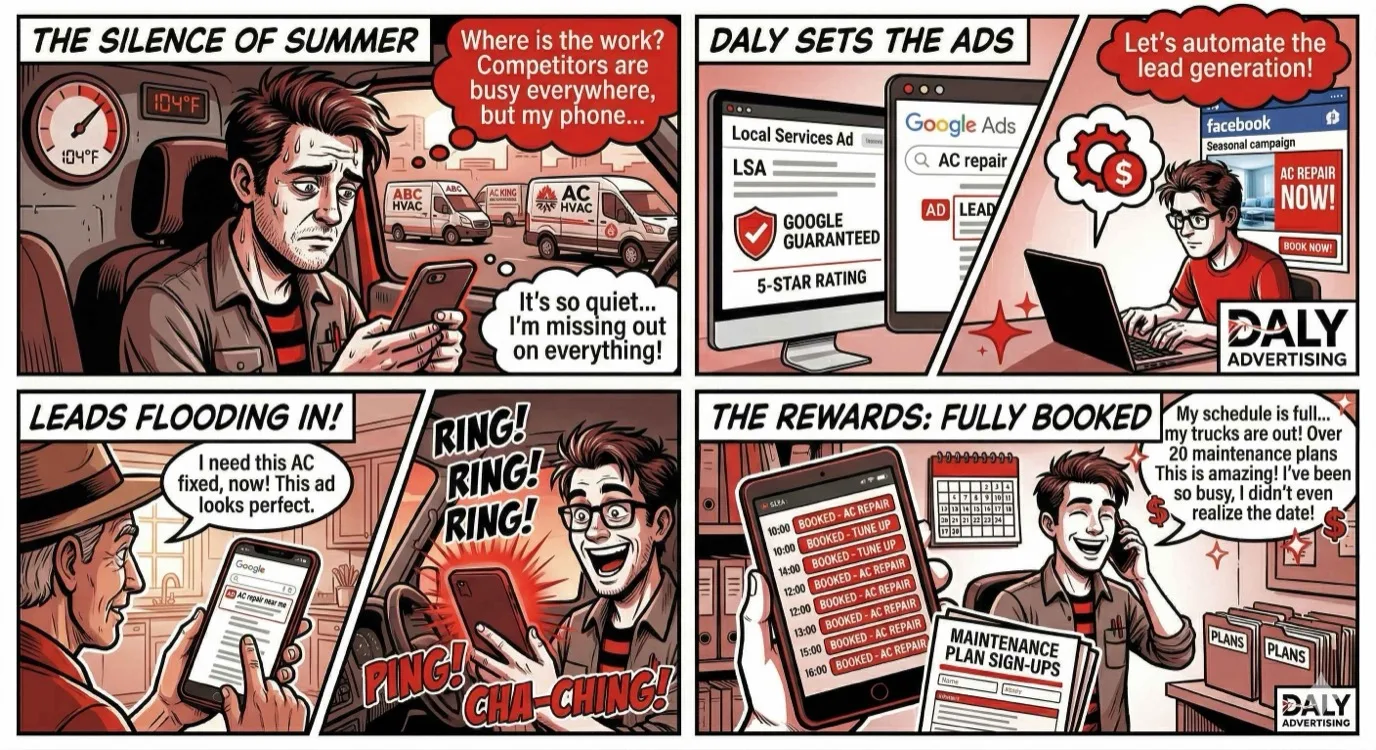
If you own or manage an HVAC company, you already know the basics: customers need heating and cooling, and they need it now. The question is not whether to advertise. The question is where to put your money so it actually comes back as booked jobs.
The three channels that dominate HVAC advertising in 2026 are Google Search Ads, Google Local Services Ads (LSA), and Facebook Ads. Each one works differently, costs differently, and attracts a different type of customer. Most HVAC companies either pick the wrong one to start with or spread their budget so thin across all three that none of them perform.
This guide breaks down exactly how each platform works for HVAC companies, what you should expect to pay per lead, and how to allocate your budget whether you are spending $1,500 or $5,000 per month. We manage Google Ads and Facebook Ads for HVAC companies across the country, so the data here comes from real campaigns, not theory.
The 3 Channels Every HVAC Company Should Evaluate
Before we break each one down, here is the fundamental difference between these three platforms:
- Google Search Ads capture people who are actively searching for HVAC services right now. They typed something into Google. They have a problem. They want a solution.
- Local Services Ads (LSA) sit above Google Search Ads and operate on a pay-per-lead model instead of pay-per-click. They carry Google's "Guaranteed" badge, which builds trust immediately.
- Facebook Ads reach people who are not searching for you. They are scrolling through their feed, and your ad interrupts them with an offer. This works best for seasonal promotions, maintenance plans, and building brand awareness.
Each channel serves a different stage of the customer journey. The mistake most HVAC companies make is treating them all the same, running the same message on every platform and expecting the same results.
Google Search Ads: Capturing High-Intent Searches
Google Search Ads are the foundation of HVAC advertising for one simple reason: they put your business in front of people who have an immediate need. When someone types "AC repair near me" at 2 PM on a 95-degree day, they are not browsing. They are ready to call.
Best Keywords for HVAC Advertising
Not all HVAC keywords are created equal. They fall into three categories, and each one has a different cost, intent level, and conversion rate.
Emergency keywords have the highest intent and the highest cost per click. These include terms like "emergency AC repair," "furnace not working," "no heat in house," and "AC stopped blowing cold." These searchers will call the first company that looks credible. Cost per click ranges from $15 to $45 depending on your market. Conversion rates typically run 8% to 15% because the urgency is real.
Maintenance keywords sit in the middle. Terms like "AC tune-up," "furnace maintenance," and "HVAC inspection" attract people who are planning ahead. Cost per click is lower, typically $8 to $20, but conversion rates are also lower because the buyer is less urgent. These keywords are valuable for building recurring revenue through maintenance plans.
Installation keywords carry the highest job value but the longest sales cycle. "New AC installation," "furnace replacement cost," and "HVAC system quote" attract homeowners who are making a major purchase decision. Cost per click ranges from $12 to $35. These leads often require follow-up and an in-home estimate before closing.
Typical Cost Per Lead for HVAC Google Ads
Across the HVAC campaigns we manage, the average cost per lead on Google Search Ads falls between $40 and $150. That range depends on your market, your competition, and the type of service being searched.
In smaller markets with fewer competitors, you can consistently generate leads at $40 to $60. In major metros like Dallas, Phoenix, or Atlanta, expect $80 to $150 per lead. Emergency service leads tend to cost more but convert to jobs at a higher rate and carry higher ticket values, so the return on investment is often better even at $120 per lead.
Ad Copy That Converts for HVAC
HVAC ad copy needs to accomplish three things in a few lines of text: establish credibility, communicate urgency, and give the searcher a reason to click your ad instead of the competitor below you.
Elements that consistently improve click-through rates in HVAC ads:
- Response time: "Same-Day Service Available" or "Technician at Your Door in 60 Minutes"
- Social proof: "4.8 Stars, 500+ Reviews" or "Trusted by 10,000+ Homeowners"
- Offers: "$49 Diagnostic Fee" or "Free Estimate on New Systems"
- Licensing and trust: "Licensed and Insured" or "Family-Owned Since 2005"
- Financing: "0% Financing Available" for installation keywords
Use ad extensions aggressively. Call extensions, location extensions, sitelink extensions (pointing to specific services like AC repair, heating, installation), and callout extensions all increase your ad's real estate on the search results page and improve click-through rates by 10% to 20%.
Landing Page Requirements
Sending Google Ads traffic to your homepage is one of the fastest ways to waste money. Every HVAC ad campaign needs dedicated landing pages built for conversion. A proper HVAC landing page includes:
- A headline that matches the search intent (if they searched "AC repair," the page should say "AC Repair" at the top)
- A prominent phone number, click-to-call on mobile
- A short form for scheduling (name, phone, service needed, preferred time)
- Trust signals: license numbers, insurance badges, manufacturer certifications, BBB rating
- Reviews embedded directly on the page
- Service area listed clearly
- No navigation menu (remove distractions that let visitors leave the page)
We have seen conversion rates jump from 4% to 12% simply by moving HVAC companies from homepage traffic to a properly built landing page. That is the difference between paying $150 per lead and $50 per lead on the same ad spend.
Local Services Ads (LSA): The Google Guaranteed Advantage
Local Services Ads have become one of the most important channels for HVAC companies since Google expanded the program nationally. If you are not running LSAs, you are giving those leads to your competitors.
How LSA Works for HVAC
LSAs appear at the very top of Google search results, above both paid search ads and the organic map pack. They display your business name, review rating, years in business, operating hours, and the green "Google Guaranteed" badge.
When a homeowner clicks on your LSA listing, they can call you directly or send a message request. You are charged per lead, not per click. This is a fundamental difference from Google Search Ads. If someone clicks your LSA profile but does not actually contact you, you pay nothing.
Google defines a "lead" as a phone call, a booked appointment, or a message request. You can dispute leads that are spam, wrong numbers, or outside your service area, and Google will typically credit those back to your account.
Pay Per Lead vs Pay Per Click
The pay-per-lead model makes LSAs significantly more predictable for budgeting. In most HVAC markets, LSA leads cost between $25 and $80 each. Compare that to Google Search Ads where you pay for every click whether it converts or not.
Here is the math: if your Google Search Ads cost $20 per click and convert at 8%, your effective cost per lead is $250. On LSA, that same lead might cost $50 to $70. The economics almost always favor LSA when it is available and performing well in your market.
The trade-off is control. With Google Search Ads, you choose your keywords, write your ad copy, and direct traffic to custom landing pages. With LSA, Google controls the matching algorithm. You set your budget, your service categories, and your service area, and Google decides when to show your listing.
Getting the Google Guaranteed Badge
To run LSAs as an HVAC company, you need to pass Google's screening process. This involves:
- Background checks on the business owner and field technicians
- License verification for your state and local HVAC licensing requirements
- Insurance verification with minimum coverage levels set by Google
- Business registration confirmation
The screening process typically takes 2 to 4 weeks. Some HVAC companies get stuck because their insurance documentation does not meet Google's specific requirements. We recommend starting the application process well before your peak season so you are not waiting for approval when leads are most valuable.
The Google Guaranteed badge itself is a powerful trust signal. Google backs jobs completed through LSA with a satisfaction guarantee up to $2,000 for the homeowner. This reduces friction for first-time customers who are comparing multiple HVAC companies.
LSA vs Search Ads: When to Use Which
The short answer: use both. They appear in different positions on the search results page and capture different user behaviors. Some homeowners click the LSA listing at the top. Others scroll past it and click a traditional search ad. Running both gives you two opportunities to appear on the same search.
That said, if you have to choose one to start with:
- Start with LSA if you have strong reviews (4.5+ stars, 50+ reviews) and want the most cost-efficient leads
- Start with Google Search Ads if you need more control over targeting, messaging, and landing pages, or if your review profile is not yet competitive
LSA performance is heavily influenced by your review count and rating. HVAC companies with 200+ reviews and a 4.8+ rating dominate LSA results in their market. If you have 15 reviews and a 4.2 rating, your LSA spend will not perform well. Focus on building reviews first, then scale LSA.
Facebook Ads: Seasonal Campaigns and Maintenance Plans
Facebook advertising for HVAC companies is fundamentally different from Google. On Google, you are capturing existing demand. On Facebook, you are creating demand. This distinction changes everything about how you structure campaigns, write copy, and measure success.
Targeting Homeowners in Your Service Area
Facebook's targeting capabilities let you get specific about who sees your HVAC ads. The most effective targeting layers for HVAC companies include:
- Geographic targeting: Your service area radius, typically 15 to 30 miles from your base
- Homeowner targeting: Facebook allows you to target people likely to be homeowners based on demographic data
- Age targeting: Homeowners aged 30 to 65 are the primary HVAC buyers
- Income targeting: For premium services and new installations, targeting higher household income brackets improves lead quality
- Homeowner interest targeting: People interested in home improvement, home maintenance, and related topics
Layering these targeting options together narrows your audience to the people most likely to need and afford HVAC services. In a metro area, a well-targeted HVAC audience might be 50,000 to 150,000 people, which is enough scale for Facebook's algorithm to optimize effectively.
Creative That Works for HVAC Facebook Ads
Because Facebook users are not actively searching for HVAC services, your creative needs to stop the scroll and create urgency where none existed. Here is what consistently performs in HVAC Facebook ad campaigns:
Seasonal tune-up offers are the highest-performing HVAC Facebook ad type. "Get your AC ready for summer, $49 tune-up, schedule before April 30" works because it is time-bound, specific, and affordable. Tune-up offers generate leads at $15 to $35 each on Facebook, making them one of the most cost-efficient HVAC ad types on any platform.
Financing promotions for new systems work well for targeting homeowners with aging equipment. "Is your AC over 10 years old? Upgrade to a new high-efficiency system, 0% financing for 60 months." These leads cost more ($50 to $100) but carry significantly higher job values ($5,000 to $15,000+).
Educational content ads build trust before asking for the sale. Short videos showing a technician explaining "3 signs your AC is about to fail" or "why your energy bill is so high" perform well as top-of-funnel awareness content. These can be retargeted later with direct offers.
Before-and-after content showing old systems replaced with new installations, dirty filters versus clean filters, or duct cleaning results all generate engagement and shares, which extends your reach organically.
Facebook for Maintenance Plan Sign-Ups
This is where Facebook really shines for HVAC companies. Maintenance plans are the backbone of recurring revenue, and Facebook is the best platform for selling them.
Why? Because maintenance plans are not something people search for on Google. Nobody types "HVAC maintenance plan near me" at 2 AM. But when a homeowner sees a Facebook ad that says "Join our Comfort Club: 2 tune-ups per year, priority scheduling, 15% off all repairs, $14.99/month," the value proposition is clear and the barrier to entry is low.
HVAC companies we work with that actively promote maintenance plans on Facebook are adding 20 to 50 new members per month at a cost of $20 to $40 per sign-up. At $180 per year per member, those customers generate predictable revenue and are 3x more likely to call you for repairs and eventually purchase a new system when theirs fails.
The lifetime value of a maintenance plan customer is typically $3,000 to $8,000 over the relationship, compared to $300 to $500 for a one-time service call customer. Facebook is the most cost-effective way to build that base.
Typical Cost Per Lead on Facebook
Facebook leads for HVAC services are generally cheaper than Google leads, but they convert to booked jobs at a lower rate because the intent is lower. Here are the benchmarks we see across campaigns:
- Tune-up and maintenance offers: $15 to $35 per lead
- Maintenance plan sign-ups: $20 to $40 per sign-up
- New system inquiries: $50 to $100 per lead
- General HVAC service leads: $30 to $60 per lead
The key metric is not cost per lead alone. It is cost per booked job. Facebook leads require faster follow-up (call within 5 minutes) and a more consultative sales approach because the customer was not actively searching. HVAC companies with strong follow-up processes see 25% to 35% of Facebook leads convert to booked jobs. Companies with slow or poor follow-up see below 10%.
Head-to-Head Comparison: Google Ads vs LSA vs Facebook
| Metric | Google Search Ads | Local Services Ads | Facebook Ads |
|---|---|---|---|
| Cost Per Lead | $40 - $150 | $25 - $80 | $15 - $60 |
| Intent Level | High (actively searching) | High (actively searching) | Low to medium (passive) |
| Lead-to-Job Rate | 20% - 35% | 25% - 40% | 10% - 25% |
| Best Use Case | Emergency repair, installation | All HVAC services | Seasonal promos, maintenance plans |
| Setup Difficulty | Medium to high | Low to medium | Medium |
| Control Level | Full (keywords, copy, pages) | Limited (Google controls matching) | Full (targeting, creative, pages) |
| Time to Results | 1 - 2 weeks | 2 - 4 weeks (including approval) | 1 - 2 weeks |
| Pricing Model | Pay per click | Pay per lead | Pay per impression/click |
| Review Dependency | Low (helps but not required) | High (reviews drive rankings) | Low |
Budget Allocation Strategy: Where to Start
How you split your HVAC advertising budget depends on how much you have to spend. Here are three scenarios based on the most common budgets we see from HVAC companies getting started with paid advertising.
Starting Budget: $1,500/Month
At $1,500 per month, you need to focus. Spreading this budget across three platforms will not generate enough data or leads on any of them. Our recommendation:
- Option A (if you have 50+ reviews at 4.5+ stars): Put $1,200 into LSA and $300 into a Google Business Profile optimization effort. LSA will be your most cost-efficient lead source at this budget level.
- Option B (if your reviews are thin): Put $1,500 into Google Search Ads targeting emergency and repair keywords only. These have the highest intent and will generate the fastest return. Use the revenue from these jobs to fund review generation.
At this budget, expect 15 to 40 leads per month depending on your market and chosen channel.
Growth Budget: $3,000/Month
At $3,000 per month, you can start running two channels effectively:
- $1,500 on LSA: Your most cost-efficient lead source for all service types
- $1,000 on Google Search Ads: Targeting installation and high-value repair keywords that LSA does not capture well
- $500 on Facebook: Running seasonal tune-up promotions or maintenance plan campaigns
At this budget, expect 40 to 80 leads per month. The Facebook campaigns at this level are testing the waters. You are learning which offers resonate with your local audience and building retargeting audiences for future scaling.
Scaling Budget: $5,000+/Month
At $5,000 or more per month, you can run a full-funnel strategy across all three platforms:
- $2,000 on LSA: Maximize your lead volume from the most cost-efficient source
- $1,500 on Google Search Ads: Full keyword coverage including emergency, maintenance, and installation terms, with dedicated landing pages for each
- $1,500 on Facebook: Seasonal campaigns, maintenance plan promotions, retargeting website visitors, and brand awareness content
At this level, you should expect 80 to 150+ leads per month. The three channels reinforce each other: Facebook builds awareness, Google captures the search demand, and LSA provides the trust signal that closes the deal.
Seasonal Timing: When to Increase HVAC Ad Spend
HVAC advertising should follow the weather, not a flat monthly budget. Smart HVAC companies increase their ad spend 30 to 60 days before their peak season and ramp back down during slow months.
Heating Season (October through February)
Start increasing budgets in late September. October and November are when homeowners realize their furnace needs service or replacement. Emergency "no heat" calls spike in November through January. Increase Google Search and LSA budgets by 30% to 50% during these months. Run Facebook campaigns promoting furnace tune-ups in September and October before the rush.
Cooling Season (April through September)
Start ramping up in March. The first hot week in your market triggers a wave of AC repair and tune-up calls. This is the highest-volume period for most HVAC companies. Peak months (June through August) justify your highest ad spend of the year. Run Facebook AC tune-up campaigns in March and April to capture early-season demand at lower costs before competition increases.
Shoulder Seasons (March, September, October)
These transition months are when cost per lead is lowest because competition drops. Smart HVAC companies use these months for maintenance plan promotions, system replacement campaigns (targeting aging equipment), and brand-building content. The leads are cheaper, and you are building pipeline for the next peak season.
Tracking: Call Tracking, CRM Integration, and Attribution
HVAC advertising without proper tracking is gambling. You need to know which channel, which campaign, and which keyword generated each lead and whether that lead became a booked job and revenue. Here is the minimum tracking setup every HVAC advertising program needs:
Call Tracking
Over 60% of HVAC leads come in as phone calls. Without call tracking, you have no idea which ads are generating those calls. Use a call tracking platform (CallRail, CallTrackingMetrics, or similar) that assigns unique phone numbers to each advertising channel. This lets you attribute every call to the ad that generated it.
Call tracking also enables call recording, which is invaluable for training your front office staff. If 30% of your calls are not being booked, improving phone handling can be more valuable than increasing ad spend.
CRM Integration
Your call tracking and form submissions should feed directly into your CRM (ServiceTitan, Housecall Pro, Jobber, or whatever platform you use). This connection lets you track the full journey: ad click to lead to booked job to completed invoice.
Without CRM integration, you know how many leads you generated but not how many turned into revenue. We regularly find that HVAC companies are spending the most money on channels that generate the most leads but not the most revenue. The channel that produces 50 leads at $30 each might generate less revenue than the channel producing 20 leads at $80 each if the higher-cost leads close at a higher rate and higher ticket value.
Attribution
Multi-channel attribution is the final piece. When a customer sees your Facebook ad on Tuesday, searches for your company name on Google on Thursday, and calls the number on your LSA listing on Friday, which channel gets credit?
For most HVAC companies, a first-touch attribution model is sufficient. This credits the first channel that introduced the customer to your business. As your advertising becomes more sophisticated, consider a multi-touch model that distributes credit across the journey.
The important thing is to have a consistent model and use it for all budget decisions. Most HVAC companies over-credit Google because it is the last click before the call, while under-crediting Facebook for introducing the customer in the first place.
Common HVAC Advertising Mistakes
After managing HVAC advertising campaigns for years, these are the mistakes we see most often:
1. Sending All Traffic to the Homepage
Your homepage is built for brand awareness and navigation. It is not built to convert a searcher who needs AC repair right now. Every ad campaign needs dedicated landing pages tailored to the service and the audience. This single change typically improves conversion rates by 2x to 3x.
2. Not Tracking Phone Calls
If you are spending $3,000 per month on ads and not tracking phone calls, you are making budget decisions with less than half the data. Call tracking costs $50 to $100 per month. There is no excuse for not having it.
3. Running the Same Budget Year-Round
HVAC demand is seasonal. Your advertising budget should be seasonal too. Spending $3,000 in July and $3,000 in January makes no sense for a company in Texas where summer is the peak season. Shift budget toward your peak months and reduce spend during slow periods.
4. Ignoring Reviews
Your review profile directly impacts the performance of every advertising channel. Google uses reviews as a ranking factor for LSA. Google Search Ads with review extensions get higher click-through rates. Facebook ads from companies with visible social proof convert better. Invest in a systematic review generation process before you scale ad spend.
5. Slow Follow-Up on Leads
HVAC leads have a short shelf life. A homeowner with a broken AC is calling multiple companies. If you call back in 2 hours, someone else already booked the job. The target response time is under 5 minutes for phone leads and under 15 minutes for form submissions. Every minute of delay costs you booked jobs.
6. No Remarketing Strategy
Only 3% to 5% of website visitors convert on their first visit. The other 95% leave without calling. Remarketing ads on Google Display and Facebook follow those visitors with your brand, reminders, and offers. Remarketing costs are low (often $5 to $15 per thousand impressions) and conversion rates are high because the audience already knows who you are.
7. Competing on Price Alone
Leading your ads with "cheapest AC repair" or "$29 service call" attracts price shoppers who are the hardest customers to retain and the most likely to leave negative reviews. Compete on speed, trust, quality, and guarantees instead. "Same-day service, 100% satisfaction guaranteed, 4.9 stars" outperforms "$29 diagnostic" for overall business health.
8. Not Testing Ad Variations
Running a single ad with no variations means you have no way to improve performance over time. Run at least 2 to 3 ad variations per campaign and let the data show you which messaging resonates. Test headlines, offers, and calls to action separately. Small improvements in click-through and conversion rates compound into significant cost savings over months.
Putting It All Together
HVAC advertising in 2026 is not about picking a single channel and hoping for the best. It is about building a system where each platform plays a role:
- LSA captures the lowest-cost, highest-trust leads from homeowners who are actively searching
- Google Search Ads fill the gaps that LSA misses and give you full control over messaging and landing pages
- Facebook builds your brand, promotes seasonal offers, and sells maintenance plans that create recurring revenue
Start with the channel that matches your current situation. If your reviews are strong, start with LSA. If you need control and custom messaging, start with Google Search Ads. If you want to build a maintenance plan base, start with Facebook. Then expand as your revenue grows.
The HVAC companies that win at advertising are not the ones with the biggest budgets. They are the ones with the best tracking, the fastest follow-up, and the discipline to let data drive their budget decisions instead of gut feelings.
We manage Google Ads, Local Services Ads, and Facebook Ads for HVAC companies across the country. If you want a team that understands the HVAC industry and knows how to turn ad spend into booked jobs, request a free audit and we will show you exactly where your current advertising is leaving money on the table.