 DALY
DALY 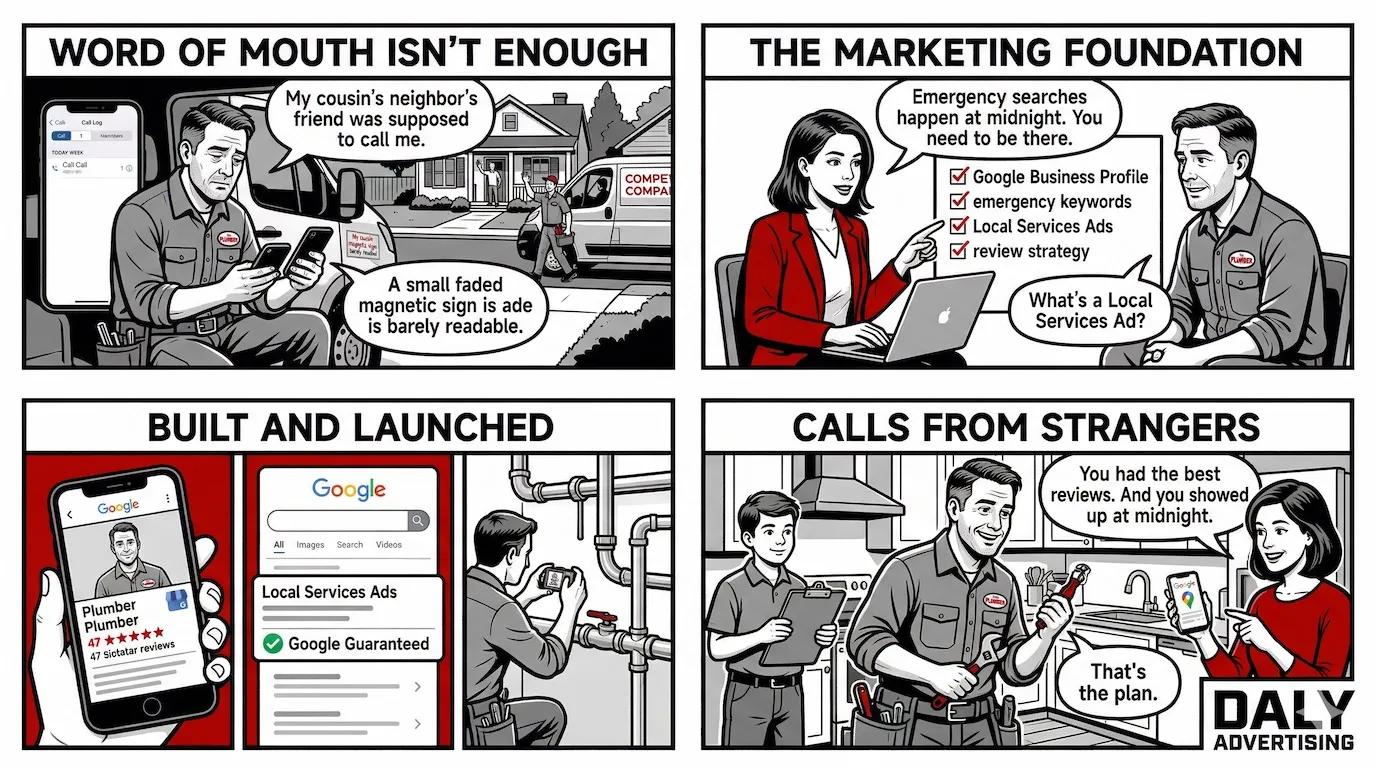
Most plumbers who call us have already spent $2,000 to $4,000 on ads that generated maybe three leads. The problem isn't that advertising doesn't work for plumbers. The problem is that plumbing has a competition index of 72 out of 100 in Google Ads - meaning you're bidding against national aggregators, franchise networks, and every other local operator in your zip code, all chasing the same 450,000 monthly searches for "plumber near me."
The plumbers winning in 2026 aren't necessarily spending more. They're stacking channels: Google Local Services Ads for immediate call volume, a tuned Google Business Profile for Local Pack visibility, and organic SEO for the long-term leads that cost nothing per click. That blended approach drops cost-per-lead by 25% compared to running paid alone. The ones stuck on a single channel - usually just Google Ads or just Yelp - are the ones watching their CPL creep past $150 while close rates stay flat.
This guide covers every layer of that system: how to set up LSA correctly, how to own the Local Pack in your service area, how to run Google Ads without bleeding budget on irrelevant clicks, and how to build a lead generation setup that keeps working when you're on a job. The numbers in here are real benchmarks, not estimates. Use them to audit what you're doing now and find the gap.
Why Plumbing Is One of the Hardest Local Markets to Win in Search
"Plumber near me" gets searched over 450,000 times per month in the United States. You'd think that volume means opportunity. It does - but only for the top 3 results. The Google Local Pack captures 44% of all clicks for local service queries, and everything below it splits the scraps.
Plumbing keywords average a competition index of 72 out of 100 in Google Ads. For context, that puts plumbing in the same tier as personal injury lawyers and insurance brokers. You're not competing against one or two local plumbers. You're competing against national lead aggregators, franchise operations, and private equity-backed service groups with dedicated media budgets.
72% of plumbing searches happen on mobile. That matters because mobile users don't scroll - they tap the first result that looks trustworthy and has a visible phone number. If you're not in the Local Pack and you're not running Local Services Ads, you're invisible to the majority of people who need a plumber right now.
Paid-Only Strategies Burn Out Fast
Running Google Ads without organic presence underneath it is like renting a storefront with no signage outside. The moment you stop paying, the calls stop. Plumbing businesses that rank in both organic results and the Local Pack see a 25% lower blended cost-per-lead than paid-only strategies. That's not a rounding error - on a $5,000/month ad budget, it's $1,250 back in your pocket every month.
The math on inaction is brutal. An average emergency plumbing call is worth $300 or more. A single missed call because you weren't ranking, or because your competitor had the Google Guaranteed badge and you didn't, costs you $300. Miss five per week. That's $1,500 gone - every week - not from a bad campaign, but from not having one at all.
Small Town vs. Metro: Strategy Shifts Based on Market Density
In a smaller market - say a city under 150,000 people - the Local Pack is winnable with strong Google Business Profile optimization and 30-40 quality reviews. The competition index drops significantly, and a focused local SEO effort can land you in the top 3 within 3-5 months.
In a major metro like Houston, Phoenix, or Chicago, the same effort gets you to page 2. Metro markets need a layered strategy from day one: Google LSA running immediately for lead flow, Google Ads for service-specific keywords, and a 12-month SEO build running in parallel. Trying to shortcut that sequence is why most plumbers give up on digital and go back to buying Angi leads.
The highest-ROI decision a plumbing business owner makes isn't which platform to advertise on. It's whether they're building owned visibility or renting it from someone else month to month.
Google Local Services Ads for Plumbers: The Verified Badge That Doubles Your Call Rate
Google Local Services Ads sit above everything else on the search results page - above standard Google Ads, above the Local Pack, above organic results. When someone searches "emergency plumber near me" at 11pm with a burst pipe, LSA is what they see first. Verified plumbers running LSA see 2-3x higher call rates compared to standard search ads alone.
LSA is not the same product as Google Ads. The difference matters.
| Feature | Google Local Services Ads | Standard Google Ads |
|---|---|---|
| Pricing model | Pay per lead (call or message) | Pay per click |
| Trust signal | Google Guaranteed badge | No badge |
| Verification required | Yes - license, insurance, background check | No |
| Position on SERP | Above all other results | Above organic, below LSA |
| Best for | Emergency and high-intent queries | Broader keyword coverage |
| Avg CPL for plumbing | Lower than Google Ads for emergency queries | $80-$150 per lead |
What the Google Guaranteed Badge Actually Does
The green checkmark badge next to your business name tells the homeowner three things: you passed a background check, your license is verified, and you carry proper insurance. Google backs it with a money-back guarantee up to $2,000 if the customer isn't satisfied with work booked through LSA. That guarantee isn't just consumer protection - it's a conversion signal that no amount of ad copy can replicate.
Most plumbers skip LSA because the verification process feels like friction. It takes 1-3 weeks and requires submitting your plumbing license, general liability insurance certificate, and consenting to a background check. Do it anyway. That friction is your moat - every competitor who skips it clears the field for you.
How LSA Pricing Works for Plumbing
You set a weekly budget, and Google charges you per verified lead - a phone call that meets a minimum duration threshold, or a direct message through the platform. You can dispute leads that don't qualify (wrong service area, already a customer, spam calls) and get credit back. That dispute process is genuinely useful. We see plumbers recover 10-15% of LSA spend monthly by disputing bad leads.
Standard Google Ads for plumbing averages $80-$150 per lead. LSA for emergency queries typically comes in lower because the conversion intent is so concentrated - someone searching "plumber near me open now" and clicking your LSA listing is already decided. They need a plumber. You just need to answer the phone.
LSA vs. Google Ads: Running Both
The right answer for most plumbing businesses with a budget over $2,000/month is to run both. LSA handles emergency, high-intent queries at the top of the page. Standard Google Ads captures service-specific keywords like "water heater replacement cost" or "drain cleaning service" where LSA coverage is thinner. Think of LSA as your emergency intake funnel and Google Ads as your service menu.
If budget is under $1,500/month, start with LSA only. Get verified, get the badge live, and let the pay-per-lead model prove ROI before adding the complexity of a full search campaign on top.
Local SEO for Plumbers: How to Own the Google Maps Pack in Your Service Area
The Local Pack - those three business listings with the map that appear for every "plumber near me" search - captures 44% of all clicks for local service queries. That's not a portion of traffic. That's nearly half of everyone searching for a plumber in your city, going to three businesses. You need to be one of them.
Google ranks Local Pack results on three factors: proximity (how close you are to the searcher), relevance (how well your profile matches what they searched), and prominence (how well-known and trusted your business appears online). You can't control proximity. You can control everything else.
Google Business Profile: The Foundation
Your primary category must be "Plumber" - not "Contractor" or "Home Services." Secondary categories should reflect your actual service mix: "Water Treatment Supplier," "Drainage Service," "Hot Water System Supplier" if applicable. Set your service area to every city and zip code you legitimately serve. Fill out every attribute Google offers: emergency service, free estimates, wheelchair accessible, payment methods. Incomplete profiles rank below complete ones, full stop.
Post to your GBP at least twice per month. Before/after job photos outperform stock images. A 400x300 photo of a completed water heater replacement with your truck visible in the background tells Google and the homeowner more than any copywritten description.
Why 50 Reviews Is the Conversion Threshold
Plumbers with 50 or more Google reviews convert at twice the rate of those with under 10. That's not about vanity. It's because 50 reviews at 4.7 stars signals a track record that 8 reviews at 5.0 stars doesn't. Homeowners are handing you the keys to their house - they want proof from other people, not promises from you.
The compliant way to generate reviews is simple: ask every completed job. An automated text sent within an hour of job completion - "Hi [Name], thanks for having us out today. If you have a moment, we'd appreciate a quick review: [link]" - gets 3x more responses than asking the next day. Don't incentivize reviews, don't ask only happy customers selectively, and don't use review gating software. All three violate Google's TOS and risk suspension.
NAP Consistency and Citation Building
NAP stands for Name, Address, Phone. If your business is listed as "Smith Plumbing LLC" on your website, "Smith Plumbing" on Yelp, and "Smith Plumbing & Drain" on HomeAdvisor, Google sees three different businesses. NAP inconsistency across 10 or more directories measurably suppresses local rankings because it introduces ambiguity about which listing is canonical.
Start with these directories and get them right before building anywhere else: Google Business Profile, Yelp, Angi, HomeAdvisor, Houzz, BBB, Thumbtack, and your local Chamber of Commerce. Use a tool like BrightLocal or Whitespark to audit existing citations before creating new ones - duplicates are as damaging as inconsistencies.
72% of plumbing searches happen on mobile, which means your GBP listing's click-to-call button is often the first touchpoint. If your phone number is wrong or inconsistent anywhere in the ecosystem, you're losing calls you never even knew you had.
For a deeper breakdown of how search optimization drives inbound calls for plumbing businesses, our plumbing SEO services page covers the full technical and local strategy we apply for plumbing clients.
Plumbing SEO: The Keyword and Content Strategy That Generates Organic Leads
There are three types of plumbing keywords, and most plumbing websites only optimize for one of them. Getting all three working together is what separates a site that generates 5 organic leads per month from one that generates 50.
| Keyword Type | Example | Intent | Best Used On |
|---|---|---|---|
| Emergency keywords | "emergency plumber near me" | Buy now - high CPC | Homepage, LSA, Google Ads |
| Service keywords | "water heater replacement cost" | Research before buying | Dedicated service pages |
| Location keywords | "plumber in [city name]" | Local intent, mid-funnel | Service area / city pages |
| How-to keywords | "how to unclog a drain" | Awareness - top of funnel | Blog content |
"Emergency plumber near me" carries one of the highest CPCs in local search - often $15-$35 per click - because advertiser competition for that intent is extreme. High CPC is a signal that the keyword converts to customers, not just browsers. Your homepage should be optimized around emergency keywords, with a click-to-call button above the fold and your city name in the title tag and H1.
Service Area Pages vs. City Pages
If you serve 5+ cities, you need dedicated pages for each one. Not a page that says "We serve Austin, Round Rock, Cedar Park, and Pflugerville." A separate URL for each city, with unique content describing the service, local service area, and ideally a reference to a neighborhood or landmark that signals genuine local presence. Service-specific pages consistently outrank generic homepages for long-tail queries because Google wants the most relevant result, not the broadest one.
A well-structured multi-location architecture looks like this: /plumber-austin/, /plumber-round-rock/, /drain-cleaning-austin/, /water-heater-replacement-austin/. Each page targets a specific service-plus-location combination. Build 10 of these before you build a single blog post.
Blog Content That Actually Ranks
Content clusters around "how to" plumbing topics drive awareness-stage traffic that converts to calls - but only if the content is built correctly. A post titled "How to Tell If You Have a Slab Leak" isn't just educational. It's targeting someone with a problem they can't solve themselves, who will call a plumber the moment the article confirms their suspicion. That article needs a call-to-action that says "If you're seeing these signs, call us now" - not "Contact us to learn more."
The blog topics with the highest conversion-to-call rate in plumbing: water heater replacement cost guides, slab leak detection symptoms, drain cleaning frequency guides, and low water pressure diagnosis. These aren't random - they all target service-aware homeowners who are already 80% of the way to calling someone.
Timeline: What to Expect Month by Month
Organic SEO for plumbing takes 4-6 months to show meaningful ranking movement in competitive markets, and 8-12 months to generate consistent lead volume. That's not a flaw in the strategy - it's why you run LSA and Google Ads in parallel during that window. The organic investment pays off as a cost reducer over time: once you're ranking, those leads cost you nothing per click. Organic and local pack presence together reduce blended CPL by 25% compared to paid-only strategies.
The same local search dynamics that drive plumbing leads apply directly to HVAC contractors. If you're running both services, our HVAC marketing strategies page covers how to structure campaigns for heating and cooling alongside plumbing without cannibalizing your own results.
Internal linking between your service pages reinforces topical authority with Google. Your water heater replacement page should link to your drain cleaning page. Your slab leak detection page should link back to your main plumbing services page. Think of it as building a web of relevance signals, not just a collection of isolated pages.
Plumbing Google Ads: How to Run Search Campaigns Without Bleeding Budget
The average plumber pays $80 to $150 per lead through Google Ads. That's a workable number if your campaign is clean. But most plumbing campaigns aren't clean - they're running broad match keywords that match searches like "plumbing school near me" and "DIY pipe repair," burning 40 to 60% of the budget on clicks that will never call.
The fix isn't spending more. It's spending tighter.
Match Type Is Where Most Budget Gets Destroyed
Broad match on a keyword like "plumber" will match anything Google decides is "related." That's a problem in a market with a competition index of 72/100, where every irrelevant click costs you $12 to $25. One month of undisciplined broad match campaigns quietly wastes $3,200 on traffic that has zero intent to hire a plumber this week.
Run exact match and phrase match only for your core emergency and service keywords. Use broad match modifier as a discovery tool for 10 to 15% of budget max, with search term reports reviewed weekly. Not monthly. Weekly.
Negative Keywords to Add Before You Launch
Your negative keyword list should be built before your first dollar goes live. Every plumbing campaign needs these from day one:
- DIY, how to, fix yourself, repair yourself
- school, course, training, certification, license exam
- jobs, hiring, career, salary, apprenticeship
- cheap, free, warranty claim
- supply, parts, hardware, depot
- diagram, blueprint, code requirement
Add to this list every week for the first 60 days. The search terms report will show you what Google actually matched your ads to. You'll find things that surprise you.
Ad Copy That Gets the Call
72% of plumbing searches happen on mobile. The person typing "emergency plumber" at 11pm isn't reading your ad carefully - they're scanning for two things: speed and trust. Your headline needs to deliver both in under 30 characters.
Include your phone number in Headline 1 on call-only ads. Use phrases like "Licensed & Insured," "Same-Day Service," and "No Trip Fee" in your descriptions - these address the three objections a homeowner has before they call a stranger to enter their house. Call-only ads outperform responsive search ads for emergency queries because they remove the click-to-website step entirely.
Geo-Targeting and Bidding
Radius targeting from your shop address sounds logical but penalizes you in high-density suburbs where your best jobs cluster. Zip code layering gives you more control - bid higher on zip codes with higher average job values, pull back on areas where your close rate is lower. This is especially relevant if you serve both a metro core and surrounding towns with different competitive dynamics. The same playbook applies to roofing contractor marketing, where bid adjustments by zone consistently lower CPL by 15 to 20%.
On bidding strategy: don't start on Target CPA. Google needs 30 to 50 conversions per month to optimize that algorithm well, and most single-location plumbers aren't there yet. Start on manual CPC with bid adjustments, build conversion history for 60 to 90 days, then switch to Target CPA with a ceiling set at your max acceptable CPL.
Know Your Max CPL Before You Set a Budget
The math is simple. Average job value: $300. Close rate on inbound calls: 40%. That means you need 2.5 leads to close one job. At $300 revenue per job, your maximum acceptable CPL is $120 if you want to break even before overhead. Anything above that and you're paying to break even - not grow. Set your Target CPA at $100 and treat $120 as the ceiling, not the target.
| Match Type | Best Use Case | Risk Level | Recommended Budget Share |
|---|---|---|---|
| Exact match | Core emergency keywords | Low | 60-70% |
| Phrase match | Service + location combos | Medium | 20-30% |
| Broad match | Discovery only, weekly review | High | 10-15% max |
A tight campaign at $2,000/month will consistently outperform a sloppy one at $5,000/month. The difference is never the budget. It's always the structure.
Seasonal Plumbing Marketing: How to Map Ad Spend and Content to Demand Spikes
Most plumbers spend the same amount on marketing every month. That's a mistake that costs real money - both by underinvesting during peak demand windows and by wasting budget during slow periods where no amount of ad spend moves the needle.
Plumbing demand isn't flat. It has four distinct windows, and each one requires a different strategy.
Q1: Pipe Burst Season - Your Highest-Intent Traffic Window
January through March represents the single highest emergency search volume window in plumbing, nationally. Frozen and burst pipes, failed water heaters, and heating system failures drive a surge in "emergency plumber near me" queries that spikes sharply in January across cold-weather markets. This is the window to have your Google LSA active, your Google Ads budget at its highest monthly allocation, and your Google Business Profile fully optimized.
If you publish seasonal content for Q1, publish it in November. Google needs 6 to 8 weeks to index, rank, and stabilize a new page. A post titled "What to Do If a Pipe Bursts in Your Home" published on January 3rd will rank in March. Published in November, it captures the whole window.
Q2: Remodel Season - Your Highest-Value Job Window
April through June shifts from emergency intent to project intent. Bathroom remodels, water heater replacements, whole-house repiping, and outdoor irrigation installs are Q2 jobs. These aren't $300 emergency calls - they're $1,500 to $8,000 projects. Your content and ads should pivot accordingly. Run campaigns targeting "water heater replacement cost," "bathroom plumbing rough-in," and "whole house repipe quote."
This seasonal pattern mirrors what you see in landscaping marketing - both industries have a Q2 project boom that rewards businesses who started their content and SEO work in Q4 of the prior year.
Q3 and Q4: Maintenance and Holiday Prep
July through September is your slower window in most markets. Use it for drain cleaning campaigns, sewer inspection promotions, and water pressure check packages. These are lower-ticket jobs but they fill the schedule and generate reviews. Q4 brings a second smaller spike - Thanksgiving week is consistently one of the highest-volume weeks for drain calls nationally (disposals and holiday cooking are a reliable combination).
How to Shift Budget Without Gaps
| Quarter | Primary Focus | Ad Budget Allocation | Content Priority |
|---|---|---|---|
| Q1 (Jan-Mar) | Emergency response | 35% of annual budget | Publish in November |
| Q2 (Apr-Jun) | Remodel and replacement | 30% of annual budget | Publish in February |
| Q3 (Jul-Sep) | Maintenance and fill | 20% of annual budget | Publish in May |
| Q4 (Oct-Dec) | Holiday prep, drains | 15% of annual budget | Publish in August |
Businesses that reallocate budget seasonally rather than spreading it flat improve ROAS by 30 to 40%. That's not a small optimization - on a $60,000 annual marketing budget, it's the difference between 18 and 24 leads per month during your highest-value quarter.
The content calendar follows the same logic: publish 6 to 8 weeks before the demand spike, not during it. By the time your competitor is scrambling to boost their Q1 ad budget, your organic pages are already ranking.
Plumbing Marketing Budget: What to Spend and Where to Allocate It
Home service businesses typically spend 5 to 10% of gross revenue on marketing. For a plumbing company doing $600,000 a year, that's $30,000 to $60,000 annually - or $2,500 to $5,000 per month. Where that money goes determines whether you grow or tread water.
The Max CPL Calculation Every Plumber Needs to Run
Before you set a budget, know your ceiling. The math: average job value multiplied by close rate equals revenue per lead. Take $300 average job, 40% close rate - that's $120 in revenue per lead. Your CPL cannot exceed $120 without destroying margin. With a blended channel mix (LSA + organic + paid), your blended CPL drops to roughly $90, which restores $30 per lead back to margin.
This isn't theoretical. In every audit we run on plumbing accounts, the operators losing money on Google Ads have one thing in common: they never calculated this number before setting their daily budget.
Budget by Business Size
| Business Size | Monthly Budget | Channel Priority | Expected Monthly Leads |
|---|---|---|---|
| Solo operator (1 truck) | $1,000/month | LSA first, GBP optimization | 8-12 leads |
| Small operation (2-3 trucks) | $3,000/month | LSA + Google Ads + local SEO | 25-35 leads |
| Regional company (5+ trucks) | $7,000+/month | Full stack: paid + SEO + retargeting | 60-90 leads |
What Each Budget Level Actually Buys
At $1,000/month, your priority is Google LSA only. Don't spread across channels. LSA delivers the lowest CPL for emergency queries and requires the least ongoing management. Get verified, get reviews, respond to every lead within 5 minutes. That's your entire strategy at this budget level - and it's enough to keep one truck busy.
At $3,000/month, layer in Google Ads on top of LSA, and invest $500 to $800 in local SEO work (GBP optimization, citation cleanup, one or two service pages). This is where the blended CPL advantage kicks in. You're no longer paying $80 to $150 for every lead - some of them come from organic and cost you nothing marginal.
At $7,000/month, you can run the full stack. Paid, LSA, SEO, retargeting, and a CRM system to follow up on unsold estimates. The operators at this budget level who win are the ones who treat marketing as a system, not a spend line. They track CPL by channel, adjust monthly, and build organic authority that compounds over time. For context, this is the same investment pattern that works in fencing company advertising - lower base volume than plumbing, but the channel mix and CPL math follow identical logic.
The ROI Math on $5,000/Month
$5,000/month. Blended CPL of $90. That's 55 leads per month. At 40% close rate, 22 jobs. At $300 average job value, $6,600 in revenue. That's a 1.32x return on paper - tight, but those are emergency-only numbers. Add one remodel job per month at $2,500 and the return jumps to 2.06x. Add upsells and repeat customers and you're looking at a 3x return within 12 months.
Marketing is the only business expense that compounds. Every good review, every ranking page, every returning customer makes the next lead cheaper.
Plumbing Marketing Tactics That Don't Work (And What to Do Instead)
The plumbing marketing industry has a long list of vendors happy to take your money for tactics that feel like marketing but don't produce calls. Most plumbers have paid for at least one of these. Here's what to stop, and what to do instead.
Angi and HomeAdvisor: Shared Leads at Full Price
Angi and HomeAdvisor send the same lead to 3 to 5 competing plumbers simultaneously. You're paying $40 to $80 for the right to race your competitors to a homeowner's phone. Close rates on shared leads average 15 to 20% - versus 35 to 45% on exclusive inbound leads from your own Google presence. You're paying more for a lead that's harder to close. That's not a channel - it's a handicap.
The alternative: build the channels that deliver exclusive leads. A homeowner who finds you through Google Maps and calls your number isn't calling four other plumbers. They found you, they chose you, and they're already warmer before you pick up.
A Website Without SEO Is an Invisible Asset
A page 2 ranking gets less than 1% of clicks - regardless of how good the website looks. We see $8,000 websites built for plumbers with zero SEO work behind them. Beautiful, fast, and invisible. A website is not a marketing asset until it ranks. The design is for conversion. The SEO is for traffic. You need both or you have neither.
The Vanity Metrics Trap
Impressions, followers, and "reach" are not business metrics. A plumbing company with 4,200 Instagram followers and 3 calls per month is losing to the competitor with 180 followers and 40 calls per month who spent that time getting Google reviews instead. Measure calls, booked jobs, and CPL. Everything else is noise.
Social Media Posting Alone Won't Fill Your Schedule
Organic social reach for service businesses averages under 5% of followers. If you have 500 followers, 25 people see each post. The math doesn't support social media as a primary lead generation channel for local plumbers. Social has a role - retargeting ads on Facebook and Instagram convert website visitors at 2 to 5x the rate of cold traffic - but that's paid, not organic. Spend an hour a week on organic social if you enjoy it. Don't mistake it for a growth strategy.
Direct Mail: When It Works and When It Doesn't
Direct mail works in two specific scenarios: new construction neighborhoods within 6 months of move-in, and post-service follow-up mailers to past customers. It does not work as a cold acquisition channel in established neighborhoods where homeowners already have a plumber in their contacts. The cost per response on cold mailers in competitive metros runs $200 to $400 - higher than Google Ads CPL with lower intent.
The One Thing Every Plumber Underinvests In
Reviews. Plumbers with under 10 Google reviews convert at half the rate of those with 50 or more. A single additional review costs you nothing except a text message sent 30 minutes after a completed job. Yet in every audit we run, the average plumbing client has fewer than 22 reviews. That gap - from 22 to 50 - is the single highest-ROI marketing investment available to most plumbing businesses right now. No ad budget required.
Your plumbing leads are going to your competitors. Find out exactly why with a channel-by-channel breakdown. Request a free marketing audit and we'll show you the gaps.
How to Build a Plumbing Lead Generation System That Runs Without You
Most plumbing owners are stuck in a loop: work the job, answer the phone, chase the next call. Marketing only happens when things slow down. That's not a system - that's a stress response. A real lead generation system runs in the background whether you're under a sink or on vacation.
Here's what that system looks like when it's built correctly.
The Three-Layer Lead Gen Stack
The most resilient plumbing marketing setups run three channels simultaneously: Google Local Services Ads at the top for verified, high-intent leads; Google Search Ads in the middle to capture demand LSA misses; and organic SEO at the base for traffic that doesn't cost you per click. Each layer covers the other's gaps. LSA doesn't reach every query. Organic takes 6 to 9 months to build. Paid fills the gap while organic catches up. None of the three works as well alone as all three work together.
Call Tracking: Know Where Every Lead Comes From
If you don't know which channel generated a call, you can't reallocate budget toward what's working. CallRail and CallTrackingMetrics both support dynamic number insertion, which means your website automatically shows a different tracking number depending on whether the visitor came from Google Ads, organic search, or a direct link. Each channel gets its own number. Each number ties back to a source. At the end of the month, you know exactly which channels are delivering leads at what cost - and which ones are just burning money.
This single setup catches more wasted spend than any campaign audit we run.
CRM Basics: Stop Losing Unsold Estimates
Plumbers who follow up on unsold estimates within 24 hours close 30% more jobs. That's not a sales tactic - it's a timing reality. Most customers who didn't book immediately are still shopping. The first contractor to follow up usually wins. A simple CRM like Jobber or ServiceTitan flags open estimates automatically and queues a follow-up text or call. You don't have to remember. The system does it for you.
Automated Review Requests
Review request texts sent within 1 hour of job completion get 3x more responses than requests sent the next day. The customer's experience is fresh, the relief of a fixed problem is real, and they haven't yet moved on to the next thing in their day. Automate this through your CRM or a tool like NiceJob. One text, one link to your Google Business Profile. The best operators run close to a 25% response rate on these. Most plumbers who do this manually get under 5%.
Retargeting: Recapture Visitors Who Left Without Calling
The majority of people who land on your website don't call the first time. They're comparing options, checking prices, or just not ready yet. Retargeting ads on Google Display and Meta show your business to these visitors for the next 7 to 30 days. Plumbing retargeting campaigns convert at 2 to 5x the rate of cold traffic because the visitor already knows who you are. The ad spend required is minimal - typically $200 to $400 per month covers meaningful retargeting volume for a local plumber.
The 5 Numbers to Track Every Month
| Metric | What It Measures | Target Benchmark |
|---|---|---|
| Total leads by channel | Which sources are generating calls and form fills | Track monthly trend, not just total |
| Cost per lead (CPL) | Ad spend divided by leads generated | Under $120 blended across all channels |
| Close rate on leads | Booked jobs divided by total inbound leads | 35-50% for inbound plumbing leads |
| Average job value | Total revenue divided by number of jobs | $250+ residential, $400+ emergency |
| Google review count (monthly adds) | Reputation growth rate | 5+ new reviews per month minimum |
These five numbers tell you everything. CPL trending up? Diagnose by channel before raising budget. Close rate dropping? Your phone team or estimate process needs work, not more leads. Average job value falling? You may be attracting the wrong query types in paid search.
The goal isn't to run more marketing. It's to run a system that makes every decision data-driven and every follow-up automatic - so you're spending your time on jobs, not chasing leads that already cost you money to generate.
Want a lead gen system built for your plumbing business? We audit your current channels, identify where leads are leaking, and build the stack that runs without you. Request a free plumbing marketing audit.
Frequently Asked Questions About Plumber Marketing
How do I market my plumbing business?
Start with three channels in this order: Google Local Services Ads for immediate verified leads, Google Business Profile optimization to rank in the Local Pack, and a service-page-focused website for organic SEO. Each channel reinforces the others. Most plumbers see the fastest ROI from LSA first because leads are pay-per-call and the Google Guaranteed badge builds instant trust.
What is the best advertising for plumbers?
Google Local Services Ads outperform standard Google Ads for most plumbing businesses because you pay per lead, not per click, and the Google Guaranteed badge increases call rates by 2 to 3 times. Standard Google Ads with exact match keywords is the right second layer. Yelp and Angi work but deliver shared leads - the same job goes to three to five competitors simultaneously.
How do plumbers get more customers?
The fastest lever is reviews. Plumbers with 50 or more Google reviews convert at twice the rate of those with under 10. Set up an automated text review request sent within one hour of job completion - response rates are three times higher than next-day requests. Combine that with LSA and a complete Google Business Profile and you'll see lift within 30 to 60 days.
How much should a plumber spend on marketing?
Industry benchmark is 5 to 10% of gross revenue for home service businesses. A plumbing company doing $500,000 per year should spend $25,000 to $50,000 annually, or roughly $2,100 to $4,200 per month. At a $300 average job value and 40% close rate, a $120 cost-per-lead still yields positive margin. Start at $2,000 to $3,000 per month if you're building from zero.
Does Google Local Services Ads work for plumbers?
Yes - LSA is one of the most effective paid channels for plumbers specifically because it targets high-intent emergency searches and charges per lead rather than per click. Verified plumbers with the Google Guaranteed badge see 2 to 3 times higher call rates than standard search ads. The verification process requires proof of license, insurance, and a background check, which most legitimate operators already have.
Your Plumber Marketing Priority Matrix
Every tactic in this guide works. But trying to run all of them at once with a limited budget and no dedicated marketing person is how things fall apart. Here's how to sequence them by impact and effort so you're building on solid ground instead of spreading thin.
| Tactic | Impact | Effort to Launch | Do This When |
|---|---|---|---|
| Google Local Services Ads | High - leads within days of approval | Medium - verification takes 1-2 weeks | First. Always first. |
| Google Business Profile optimization | High - drives Local Pack visibility | Low - can be done in a few hours | Same week as LSA setup |
| Review generation system | High - 2x conversion rate at 50+ reviews | Low - automate with a text tool | Immediately after GBP is complete |
| Google Ads (exact + phrase match only) | High - fills gaps LSA doesn't cover | Medium - needs proper setup and negatives | Once LSA is active and converting |
| Service page SEO + city pages | High long-term, slow to start | High - requires content and link building | Month 2 or 3, run parallel to paid |
| Seasonal content calendar | Medium - compounds over time | Medium - requires planning ahead | 6-8 weeks before Q1 and Q2 peaks |
| Retargeting + CRM follow-up | Medium - recovers lost estimates | Low once set up | After call tracking is in place |
The math is not complicated. If your average job is worth $300 and you close 40% of leads, you can afford up to $120 per lead and still make money before overhead. The goal of everything in this guide is to push your blended cost-per-lead below that number - and keep it there as volume scales.
One more thing worth saying directly: the plumbers who struggle with marketing aren't bad at their craft. They're trying to run a business, manage a crew, and figure out Google Ads at the same time. The system described in this guide - LSA plus Local Pack plus organic SEO - is designed to run mostly without your daily attention once it's built correctly. That's the actual goal. Not just more calls, but calls that come in without you having to stop everything to chase them.
Want us to audit your current plumbing marketing setup? We'll identify exactly where your budget is leaking and which channels are worth scaling - no generic recommendations, just numbers from your actual campaigns. Request a free audit and we'll have findings back to you within 48 hours.