 DALY
DALY 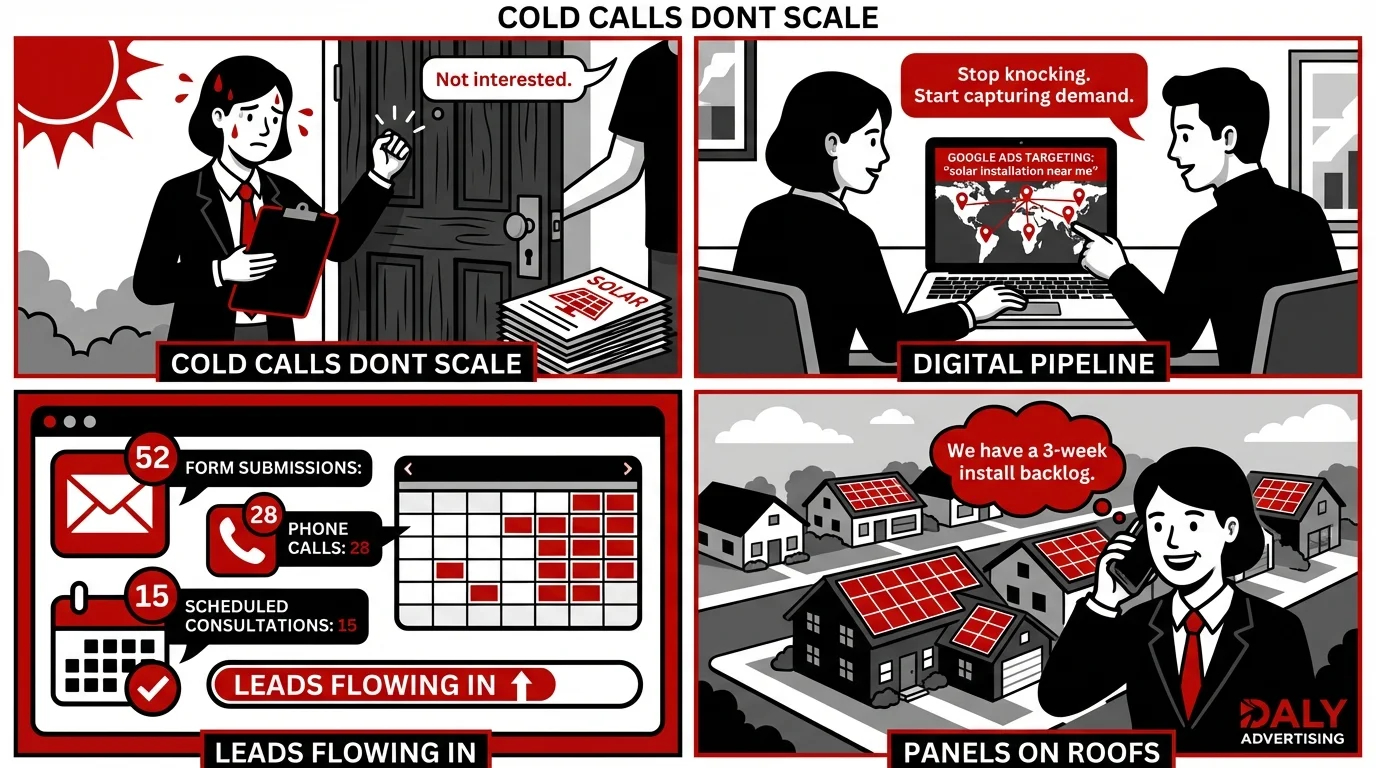
The U.S. residential solar market installed 6.2 GW in 2025 - a record - and the average residential system now sells for $25,000 to $35,000 after incentives. That deal size makes solar one of the highest-value lead generation games in all of home services. A single closed deal can return 5x to 10x your marketing cost. But here is the other side of that equation: the average solar company pays $200 to $400 to acquire a single customer, competition is brutal in every major market, and the companies buying shared leads from aggregators are watching their margins evaporate.
Solar marketing is not harder than marketing other home services. It is different. The sales cycle is longer (30 to 90 days versus same-week for HVAC or plumbing). The ticket is higher, which means the buyer does more research before committing. And the regulatory landscape - net metering changes, ITC step-downs, state incentives - shifts the value proposition every year. Your marketing has to account for all of this.
This guide covers every channel that generates solar leads in 2026: Google Ads, Facebook, SEO, reviews, referrals, content marketing, and the role of door-to-door in a digital-first world. We include real benchmarks on cost per lead, close rates, and what to actually expect at different budget levels. If you run a solar installation company and want more installs without guessing where to spend, this is the playbook.
The Solar Lead Generation Landscape in 2026
Before diving into channels, you need to understand how solar buyers actually behave, because it dictates your entire strategy.
The typical residential solar buyer goes through a 60 to 90 day research phase. They start with a Google search like "how much do solar panels cost" or "is solar worth it in [state]." They read 3 to 5 articles, visit 2 to 3 installer websites, check reviews, and then request quotes from 2 to 4 companies. The company that shows up first, most often, and with the most credible trust signals usually wins the deal - even if their price is not the lowest.
This means your marketing system needs to work across the entire funnel:
- Top of funnel: Awareness through Facebook Ads, content marketing, and educational SEO content that reaches homeowners before they start actively shopping
- Middle of funnel: Retargeting, email nurture, and review signals that keep your company top-of-mind during the research phase
- Bottom of funnel: Google Ads, LSA, and high-intent SEO pages that capture the homeowner when they are ready to request a quote
Most solar companies only market to the bottom of the funnel. They run Google Ads, fight over the same expensive keywords, and wonder why their cost per acquisition keeps climbing. The companies scaling efficiently are the ones building the full funnel.
Google Ads for Solar Companies
Google Ads is the highest-intent paid channel for solar lead generation. When someone searches "solar panel installation near me," they are actively looking for an installer. That intent is worth paying for.
Keyword Strategy and CPC Benchmarks
Solar keywords are expensive but not uniformly so. Here is how they break down:
| Keyword Type | Examples | Avg. CPC | Conversion Rate | Intent Level |
|---|---|---|---|---|
| High-intent commercial | "solar installation [city]," "solar panel installers near me" | $20 to $45 | 12 to 20% | Highest |
| Brand comparison | "best solar companies in [state]," "top rated solar installers" | $15 to $30 | 8 to 15% | High |
| Cost/savings queries | "solar panel cost [state]," "how much do solar panels save" | $10 to $25 | 5 to 10% | Medium |
| Informational | "is solar worth it," "solar panel pros and cons" | $5 to $15 | 2 to 5% | Lower |
| Incentive-related | "solar tax credit 2026," "solar incentives [state]" | $8 to $20 | 4 to 8% | Medium |
Focus your budget on the top two rows. The informational and incentive keywords are better served by SEO content than paid clicks - you do not want to pay $15 for a click from someone who is 60 days away from buying.
Campaign Structure That Works
The biggest mistake solar companies make with Google Ads is running one campaign with broad match keywords and hoping for the best. Here is the structure that actually performs:
- Campaign 1 - High Intent: Exact and phrase match keywords for "solar installation," "solar installer," and "solar company" plus city modifiers. This is your money campaign. Bid aggressively.
- Campaign 2 - Competitor Conquesting: Bid on competitor brand names in your market. CPCs are lower ($8 to $15), and you capture homeowners who are already in buying mode but have not committed yet.
- Campaign 3 - Cost/Savings: Target cost-related searches with landing pages that lead with savings calculators and ROI projections. Conversion rate is lower, but these leads enter your nurture funnel.
With this structure, a $5,000 per month Google Ads budget in a mid-size market typically generates 60 to 100 leads at $50 to $85 per lead. At a 20% close rate (realistic for exclusive, high-intent leads), that is 12 to 20 closed deals per month. On average deal values of $25,000 to $30,000, the return on ad spend is substantial. This is the same math-first approach we use across all home services marketing - the numbers have to work before you scale.
Negative Keywords Are Critical
Solar Ads campaigns bleed money without aggressive negative keyword lists. Add these from day one:
- "solar panel DIY," "how to install solar panels yourself"
- "solar jobs," "solar careers," "solar technician salary"
- "solar farm," "commercial solar" (unless you do commercial)
- "free solar panels" (these leads almost never convert)
- "solar lease vs buy" (better served by content, not ads)
We see solar companies waste 20 to 35% of their ad spend on irrelevant clicks simply because they never built a negative keyword list. That is $1,000 to $1,750 per month thrown away on a $5,000 budget.
Facebook and Meta Ads for Solar Lead Generation
Facebook Ads serve a fundamentally different purpose than Google Ads for solar companies. Google captures existing demand. Facebook creates it. Both are necessary, but they require completely different creative, targeting, and expectations.
Why Facebook Works for Solar
Solar is a consideration purchase, not an impulse buy. But Facebook's targeting lets you reach the exact homeowner profile that converts: homeowners (not renters) in specific zip codes, with household income above a threshold, who own single-family homes. That targeting precision is why solar Facebook Ads can generate leads at $15 to $50 per lead - significantly cheaper than Google. The tradeoff is that these leads are earlier in the buying cycle and close at 5 to 12% versus 15 to 25% for Google.
Ad Creative That Converts
The solar Facebook Ads that perform best in 2026 follow a consistent pattern:
- Lead with savings, not technology. "This homeowner in [city] cut their electric bill by $187/month" outperforms "We install high-efficiency monocrystalline panels" by 3x to 5x in click-through rate.
- Use real local imagery. Stock photos of generic solar panels on perfect roofs underperform real installation photos from your jobs by 40 to 60%. Homeowners want to see what solar looks like on houses in their neighborhood.
- Include the incentive. "The 30% federal tax credit won't last forever" is a strong urgency driver. Pair it with state-specific incentives for maximum impact.
- Video outperforms static. A 30-second before/after video showing the installation process and the homeowner's first electric bill generates 2x to 3x more leads than static image ads.
For a deeper comparison of when to use each platform, our Facebook Ads vs Google Ads breakdown covers the strategic differences in detail. The principles apply to solar just as much as ecommerce.
Lead Form Ads vs Landing Page Ads
Facebook offers two lead capture methods: native lead form ads (the user fills out a form without leaving Facebook) and traffic ads that send people to your landing page. For solar, we consistently see lead form ads generate 2x to 3x more volume at a lower cost per lead. The tradeoff is lead quality - lead form submissions are easier (fewer friction steps), which means more tire-kickers.
The solution: add qualifying questions to your lead form. Ask about homeownership status, roof age, and current electric bill amount. This filters out renters and low-usage households, improving lead quality by 30 to 50% with only a modest increase in cost per lead.
SEO for Solar Companies: The Long Game That Pays Off
SEO is the single most cost-effective lead generation channel for solar companies over a 12-month horizon. The catch is that it takes 4 to 6 months to start generating meaningful leads. If you need leads this week, start with paid. But if you are not investing in SEO simultaneously, you will be paying for every click forever.
The Pages You Need
Solar SEO is not about blogging. It is about building the right pages that match what homeowners actually search for:
- City service pages: "Solar Panel Installation in [City], [State]" - one for every city you serve. Include local permits, utility company details, and average savings for that area. These rank for "[city] solar installation" and drive the highest-intent organic traffic.
- State incentive pages: "[State] Solar Incentives and Tax Credits 2026" - these rank for incentive-related searches and capture middle-of-funnel buyers who are researching the financial case for solar.
- Solar cost pages: "How Much Do Solar Panels Cost in [State]" - one of the highest-volume search queries in the solar space. A comprehensive, honest cost page builds trust and generates leads from homeowners in the research phase.
- Comparison pages: "Solar Panels vs. Generator," "Solar Lease vs. Buy," "[Your Company] vs. [Competitor]" - these capture searchers who are actively comparing options.
A solar company with 15 to 20 well-optimized city pages, 3 to 5 state-level resource pages, and consistent blog content targeting long-tail keywords can generate 40 to 80 organic leads per month within 9 to 12 months. At that point, your effective cost per lead from SEO drops to $15 to $30 - a fraction of what you pay per lead on Google Ads.
Google Business Profile for Solar
Your Google Business Profile is arguably more important than your website for local solar leads. When someone searches "solar companies near me," the Map Pack results appear above the organic results. To rank in the Map Pack, you need:
- A complete, verified GBP with accurate service area settings
- Consistent review velocity (more on this below)
- Regular posts with installation photos and savings data
- Correct primary category ("Solar Energy Contractor") and secondary categories
- Q&A section populated with common buyer questions and thorough answers
Many solar companies neglect their GBP entirely and wonder why they do not appear in local results. If you are running paid ads but ignoring your GBP, you are leaving free leads on the table. For the complete playbook on local visibility, our home services SEO guide covers GBP optimization, review strategy, and local ranking factors in detail.
Review Strategy: The Trust Multiplier
Solar is a high-trust purchase. A homeowner is making a $25,000+ decision that sits on their roof for 25 years. Reviews are not optional - they are the single most important trust signal in your marketing stack.
The Numbers That Matter
Here is what the data shows for solar specifically:
- Solar companies with 100+ Google reviews close leads at 22 to 28% higher rates than those with fewer than 30 reviews
- A 4.7 star rating is the sweet spot. Anything below 4.5 loses leads. Perfect 5.0 ratings actually reduce trust (consumers suspect they are fake)
- Review recency matters as much as volume. A company with 200 reviews but nothing in the last 3 months loses to a company with 80 reviews and 10 in the last month
- Reviews that mention specific dollar savings ("saved $2,400 per year"), installation quality, or crew professionalism convert browsers to leads at 2x the rate of generic "great job" reviews
How to Generate Reviews Consistently
The best time to ask for a review is when the system is turned on and the homeowner sees their meter running backwards for the first time. That emotional high point is your moment. Build a systematic process:
- Send an automated text with a direct Google review link on the day of system activation
- Follow up with an email 3 days later that includes a photo of their completed installation
- If they have not left a review after 7 days, have the sales rep who closed the deal send a personal text
- Aim for a 30 to 40% review capture rate. If you are closing 15 deals per month, that is 5 to 6 new reviews per month - enough to maintain strong velocity
Referral Programs: Your Lowest-Cost Lead Source
Referrals are the best-converting, lowest-cost leads any solar company will ever get. A referred lead closes at 35 to 50% - nearly double the close rate of paid leads - because the trust is pre-established by the person who referred them.
The problem is that most solar companies treat referrals as passive. They hope satisfied customers will mention them to neighbors. Hope is not a strategy. Here is what works:
- Cash incentives: $500 to $1,000 per closed referral is standard in the solar industry. On a $28,000 average deal, that is a 2 to 4% acquisition cost - far cheaper than any paid channel.
- Tiered programs: $500 for the first referral, $750 for the second, $1,000 for the third. This gamifies the process and identifies your best advocates.
- Neighborhood campaigns: After installing in a neighborhood, offer the customer a bonus if their neighbors sign up within 60 days. Solar is visual - when one house gets panels, the neighbors notice. A targeted mailer plus a customer referral bonus can generate 2 to 4 additional deals per installation in dense neighborhoods.
- Timing: Introduce the referral program at system activation, not at sale. The customer needs to experience the savings before they will authentically recommend you.
Door-to-Door vs. Digital: The Hybrid Approach
The solar industry has a unique relationship with door-to-door sales. Companies like Vivint, Sunrun, and dozens of regional installers built their businesses on D2D. It still works - D2D accounts for roughly 30 to 40% of residential solar sales nationally. But the economics are shifting.
The D2D Cost Problem
A full-time solar canvasser costs $60,000 to $90,000 per year in base salary plus commissions. Average rep turnover in solar D2D is 60 to 80% annually, meaning you are constantly recruiting and training. Factor in management overhead, vehicle costs, and the ramp-up period for new reps, and your fully loaded cost per D2D-sourced deal often hits $1,200 to $2,000. That is competitive with digital acquisition costs, but without the scalability benefits.
Why Hybrid Wins
The smartest solar companies are not choosing between D2D and digital. They are using digital to make D2D more effective:
- Pre-warm territories with digital ads. Run Facebook and Instagram ads in specific zip codes for 2 to 3 weeks before sending canvassers. When the rep knocks, the homeowner has already seen your brand 5 to 7 times. Recognition cuts the rejection rate by 25 to 35%.
- Use satellite data for targeting. Google's Project Sunroof and similar tools identify homes with high solar potential based on roof size, orientation, and shade. Target your D2D reps at homes with the best solar profiles instead of canvassing entire neighborhoods blindly.
- Digital follow-up for D2D leads. A canvasser who gets a "not right now" can add the homeowner to a remarketing audience. That homeowner then sees your ads for the next 90 days. When they are ready, you are the company they remember.
The hybrid approach typically reduces overall customer acquisition cost by 20 to 30% compared to pure D2D, while maintaining the personal touch that drives trust in high-ticket residential sales.
Content Marketing for Solar Companies
Content marketing is the bridge between SEO and lead generation for solar. The right content attracts organic traffic, builds authority, and nurtures leads through a long sales cycle. The wrong content is a waste of time and money.
Content That Generates Leads
Focus on content that answers real buyer questions with specific, local data:
- Savings calculators and cost guides: "How Much Do Solar Panels Cost in Texas in 2026?" with real pricing data, incentive breakdowns, and payback period analysis. These pages rank for high-volume keywords and convert at 3 to 5%.
- Incentive explainers: "The Complete Guide to Florida Solar Incentives" - updated annually, covering federal ITC, state credits, utility rebates, and net metering policies. These build trust and rank for incentive-related searches.
- Case studies: "How the Martinez Family in Phoenix Cut Their Electric Bill by $210/Month" with real numbers, real photos, and the actual system specs. Case studies are the highest-converting content type for solar because they provide social proof with specifics.
- Comparison content: "Solar Panels vs. Tesla Powerwall: What You Actually Need" or "Is Solar Worth It If You Have Low Electric Bills?" These capture searchers in the consideration phase.
Avoid generic content like "5 Benefits of Solar Energy" or "How Solar Panels Work." Every solar company publishes this. It ranks for nothing and converts nobody. For a broader look at how AI can accelerate your content production without sacrificing quality, see our AI lead generation guide.
Email Nurture for Long Sales Cycles
A homeowner who requests a quote today might not sign for 60 to 90 days. If you are not nurturing that lead via email, a competitor will close them. Build a 90-day email sequence:
- Days 1 to 3: Immediate follow-up with a personalized savings estimate and next steps
- Week 1: Send a case study from a recent install in their area
- Week 2: Share a breakdown of the federal tax credit and state incentives they qualify for
- Week 4: Address common objections - roof condition, panel aesthetics, and what happens when they sell the house
- Week 6: Offer a limited-time incentive (free panel upgrade, waived permit fees, referral bonus for signing by a date)
- Week 8 to 12: Monthly check-ins with updated savings projections based on rising utility rates
Companies with an active email nurture sequence close 15 to 25% more of their existing pipeline without spending any additional money on lead generation. It is the highest-ROI marketing activity most solar companies are not doing.
Budget Allocation: Where to Spend at Every Level
Here is how to allocate your solar marketing budget based on your monthly spend:
| Channel | $5K/month | $10K/month | $20K/month |
|---|---|---|---|
| Google Ads | $2,000 (40%) | $3,500 (35%) | $7,000 (35%) |
| Facebook/Meta Ads | $1,250 (25%) | $2,500 (25%) | $4,000 (20%) |
| SEO + Content | $1,000 (20%) | $2,500 (25%) | $5,000 (25%) |
| Review Management | $250 (5%) | $500 (5%) | $1,000 (5%) |
| Referral Program | $500 (10%) | $1,000 (10%) | $2,000 (10%) |
| Email/CRM | $0 (DIY) | $0 (DIY) | $1,000 (5%) |
At the $5,000 level, you are building your foundation: capturing high-intent search traffic, testing Facebook creative, and starting the SEO engine. At $10,000, you have enough to run full campaigns across both paid platforms while investing meaningfully in organic. At $20,000, you can scale what is working, add dedicated content production, and build out a CRM-driven nurture system.
The key metric to track is not cost per lead. It is cost per closed deal. A $100 Google Ads lead that closes at 20% gives you a $500 customer acquisition cost. A $30 Facebook lead that closes at 7% gives you a $429 customer acquisition cost. The cheaper lead is not always the better lead - track the full funnel.
Measuring What Matters: Solar Marketing KPIs
Solar companies drown in data but often track the wrong metrics. Here are the numbers that actually determine whether your marketing is working:
- Cost per qualified lead (CPL): Not cost per form submission - cost per lead that is a homeowner, in your service area, with a suitable roof. Target: $50 to $100 from paid, $15 to $30 from organic.
- Lead to appointment rate: What percentage of leads book a consultation? Below 40% means your speed to lead is too slow or your qualification process is broken.
- Appointment to proposal rate: What percentage of consultations result in a proposal? Below 70% means your sales team is wasting time on unqualified appointments.
- Proposal to close rate: Industry average is 25 to 35%. Below 20% is a pricing or sales process issue, not a marketing issue.
- Customer acquisition cost (CAC): Total marketing spend divided by closed deals. Target: $500 to $1,200 for residential solar. Anything above $1,500 and your margins are getting squeezed.
- Speed to lead: How fast do you respond to a new inquiry? Leads contacted within 5 minutes are 9x more likely to convert than leads contacted after 30 minutes. This single metric can move your close rate by 10 to 15 points.
Frequently Asked Questions
How much does a solar lead cost?
Solar lead costs vary by channel and exclusivity. Google Ads leads typically run $40 to $120 per lead depending on your market and keyword targeting. Facebook leads are cheaper at $15 to $50 but convert at lower rates. Google Local Services Ads deliver leads in the $30 to $80 range with higher intent. Shared leads from aggregators cost $20 to $60 but close at only 3 to 8% because 4 other installers got the same lead. Exclusive leads from your own campaigns cost more upfront but deliver a dramatically lower cost per closed deal.
Is Google Ads or Facebook Ads better for solar companies?
Google Ads captures people actively searching for solar installation, so it delivers higher-intent leads that close faster - typically 15 to 25% close rate versus 5 to 12% for Facebook. Facebook Ads is better for demand generation: reaching homeowners who have not started searching yet but fit the profile. The best solar marketing strategies use both. Google Ads handles the bottom of the funnel, while Facebook fills the top with awareness and remarketing. Most solar companies should allocate 60% of paid budget to Google and 40% to Facebook.
How long does SEO take to work for solar companies?
Expect 4 to 6 months before SEO generates consistent organic leads for a solar company. The first 90 days are foundation work: fixing technical issues, building city-specific service pages, optimizing your Google Business Profile, and creating content. Months 4 through 6, you start ranking for longer-tail keywords and seeing organic traffic climb. By month 9 to 12, a well-executed SEO strategy compounds into 30 to 50+ organic leads per month in mid-size markets, at effectively zero cost per lead.
How much should a solar company spend on marketing?
The industry benchmark is 8 to 12% of target revenue for solar companies in growth mode. A company targeting $3 million in annual revenue should budget $240,000 to $360,000 per year, or $20,000 to $30,000 per month across all channels. A practical starting budget is $5,000 to $8,000 per month split across Google Ads (40%), Facebook Ads (25%), SEO (20%), and review management plus referral programs (15%).
Do door-to-door sales still work for solar?
Door-to-door is still the single largest lead source for many solar companies, accounting for 30 to 40% of residential solar installs nationally. But it is getting harder and more expensive. Rep turnover averages 60 to 80% annually, training costs are high, and municipalities are increasingly requiring solicitation permits. The companies that combine D2D with digital marketing outperform those relying on either alone. The hybrid approach - pre-warming territories with digital ads before sending canvassers - typically reduces customer acquisition cost by 20 to 30% compared to D2D only.
Want a solar marketing strategy built for your market? We build channel-specific marketing plans for solar installers based on your territory, competition, and revenue targets. No cookie-cutter packages - just the channels and budget that make sense for your business. Request your free audit here.